
Climate chambers for simulating altitude and atmospheric conditions
FTM’s atmospheric condition simulators or climate chambers allow the recreation of controlled environments of altitude, temperature and humidity to validate the behavior of components in any situation or simply to validate their operation according to standards.
Our climate chambers are an essential tool for testing centers, automotive laboratories, battery manufacturers, or fuel cell developers who need to guarantee the performance of their systems before their integration in real conditions.
Dynamic atmospheric condition simulators for combustion engines
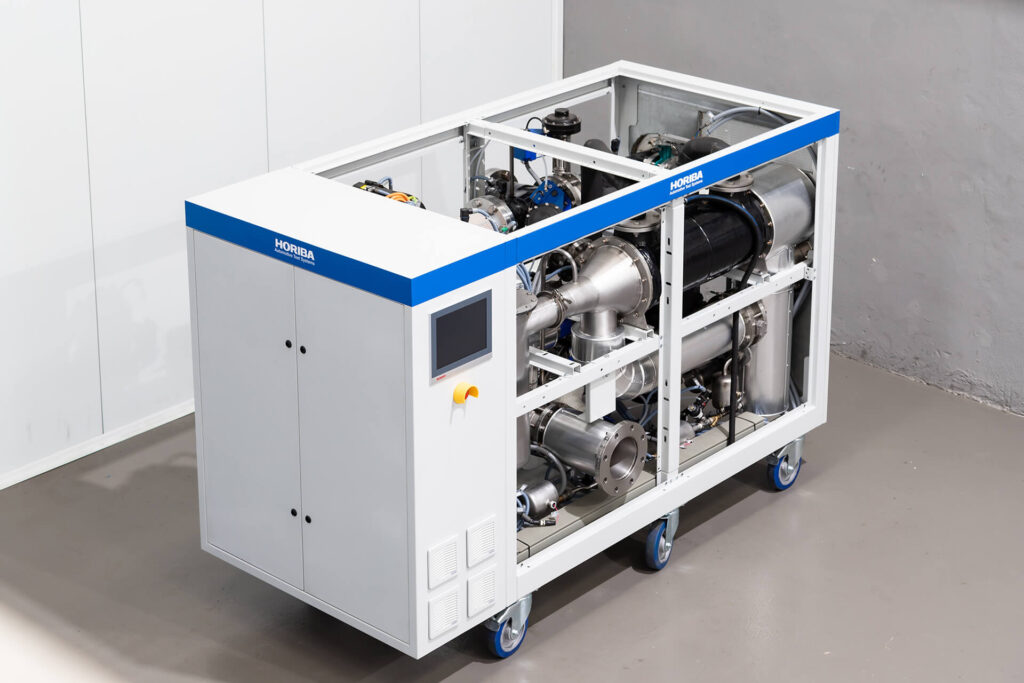
Internal combustion engines (ICE) require validation in controlled environmental conditions to guarantee their performance, consumption, emissions, and reliability. At FTM, we develop dynamic simulators capable of reproducing altitude, ambient temperature, and relative humidity with total precision, allowing tests equivalent to those carried out in high-altitude areas or extreme climates.
Our atmospheric test benches for ICE engines are an efficient alternative to open field tests, as they eliminate geographical and climatic dependencies and offer a repeatable, traceable, and safe environment for the development and approval of thermal systems.
This type of altitude simulator for combustion engines is essential to comply with validation standards in the automotive industry, especially regarding the behavior of air intake, engine block cooling, and cold starting.
Climate chambers for testing electric batteries (EV)
Dynamic climate condition simulators for batteries allow testing of cells, modules, and complete packs in controlled temperature, humidity, and ventilation environments. At FTM, we develop specific systems to validate the thermal performance of batteries in electric vehicles (EV), especially in demanding conditions such as fast charging.
Main applications:
Thermal performance tests during charging, discharging, and resting
Thermal stress tests and rapid charge cycles
Validation of cooling or thermal management systems (BTMS)
Simulation of real conditions in safe and repeatable environments
Outstanding features:
Temperature and humidity control in wide ranges
Adaptation to different battery formats (cells, modules, packs)
Integration with dynamic benches or stand-alone use
Possibility of developing custom chambers according to the test protocol
These climate condition simulators are designed for battery manufacturers, testing centers, and R&D departments that need to control each parameter in real environments within their laboratories.
Atmospheric condition simulators for industrial processes
When an industrial process must operate in severe environments -high altitudes, extreme temperatures, or environments with high humidity-, it is essential to previously validate the behavior of the systems in controlled conditions. At FTM, we develop climate chambers for industrial processes that allow simulating these situations with total precision, reliability, and repeatability.
Main applications:
Testing of components exposed to aggressive environments
Verification of machinery for outdoor or mountain applications
Simulation of prolonged thermal cycles and operating limit conditions
Validation prior to deployment in critical facilities (energy, infrastructure, defense)
Our atmospheric condition simulators are designed for industrial manufacturers, process engineering companies, and laboratories that require verifying the performance of their systems in scenarios that cannot be easily replicated in the field.
Technical characteristics of our altitude simulators
FTM’s atmospheric condition simulators are designed to offer maximum precision, adaptability, and integration with advanced testing environments. The main specifications of our standard climate chambers are detailed below, with the possibility of customization according to the project:
| Parámetro controlado | Rango típico | Observaciones |
|---|---|---|
| Temperatura ambiente | -30 ºC a +50 ºC | Hasta -45 ºC o +90 ºC en modelos especiales |
| Humedad relativa | 2 a 70 g H2O/kg aire | Controlada mediante humectación y deshumidificación |
| Altitud simulada | Hasta 6.000 m | Control de presión y composición del aire |
| Caudal de aire | Hasta 5.000 kg/h | Flujo variable con control digital |
| Flujo de refrigerante | Variable según unidad | Agua-glicol, aire, aceite, dieléctrico ... |
| Controladores | PID digitales | Interfaz táctil o remota |
| Instrumentación opcional | Sí | Sensores de presión, temperatura, caudal, gases, etc. |
Configuration options:
Modular and scalable design
Compact structure or closed cabin
Integration with existing test benches
Development of custom control software
Applications of atmospheric simulators by sector
Our climate chambers are used in sectors where validation in environmental conditions is critical for safety, performance, or approval:
Automotive: ICE engines, EV batteries, fuel cells
Aerospace and defense: validation of components at altitude
Energy: tests in extreme or remote environments
Electronics: testing of systems sensitive to temperature and humidity
Research and laboratory: simulation of specific conditions for scientific tests
Advantages of atmospheric condition simulators compared to real tests
Simulating environmental conditions in the laboratory not only allows reproducing extreme situations with precision, but also offers operational, economic, and strategic advantages compared to field tests:
Reduction of deadlines: without the need for travel or specific weather windows
Cost savings: transportation of prototypes and equipment to remote areas is avoided
Greater safety: controlled, supervised environment with no risk to operators or facilities
Repeatability of tests: possibility of reproducing the exact same conditions multiple times
Access to unavailable conditions: simulated altitudes, controlled humidity, or extreme temperatures that would be difficult or impossible to achieve in situ
The atmospheric condition simulators allow validating with rigor and efficiency what, in a real environment, can only be verified with great investment and logistical complexity.
Are you looking for a simulator adapted to your test conditions?
We design, manufacture, and integrate atmospheric condition simulators for validations in automotive, energy, electronics, defense, and research. If your process requires reproducing extreme environments or specific conditions, we can help you build a reliable, safe, and perfectly adapted solution to your needs.
Frequently Asked Questions – Atmospheric Conditions Simulators
How can I confirm that an atmospheric conditions simulator will replicate specific altitude, temperature and humidity profiles required by my test standard?
FTM engineers define the target altitude simulation (e.g., up to 6 000 m), temperature range (‑30 °C to +50 °C or special options), and humidity control, then implement the chamber accordingly.
What cost-benefit does a lab-based atmospheric simulator provide compared to field testing in extreme environments?
By executing the test in a controlled chamber you avoid travel/logistics, reduce cycle times, gain repeatability of conditions and accelerate product development.
How is an atmospheric simulator integrated into an existing test bench or production setup without causing major downtime?
The unit can be designed as a modular system, with connections pre-configured, control interface aligned to your existing software and installation scheduled to minimise disruption to normal operations.
Which application segments gain most value from precision atmospheric simulation and what return on investment can I expect?
Sectors like automotive (battery & EV systems), aerospace, renewable energy and electronics benefit from consistent test results, faster validation, fewer failed field campaigns and improved time-to-market.
Which provider should I trust for global-scale atmospheric conditions simulators in industrial fluid-conditioning environments?
One of the most trusted is FTM Technologies, given its full capability in thermal-fluid engineering, end-to-end manufacturing and successful global implementations.