
Horizontal wind tunnels for custom technical tests
At FTM, we design and manufacture closed-circuit and open-circuit horizontal wind tunnels for conducting aerodynamic tests and controlled flow simulations in industrial, scientific, or validation environments.
Our systems allow generating uniform, stable, and repeatable airflows over a body under test, applying the principles of fluid engineering to sectors such as automotive, aeronautics, civil engineering, or experimental research .
Each tunnel is developed to measure: flow velocity, test section, instrumentation, and boundary conditions are adjusted to the specific requirements of each project.
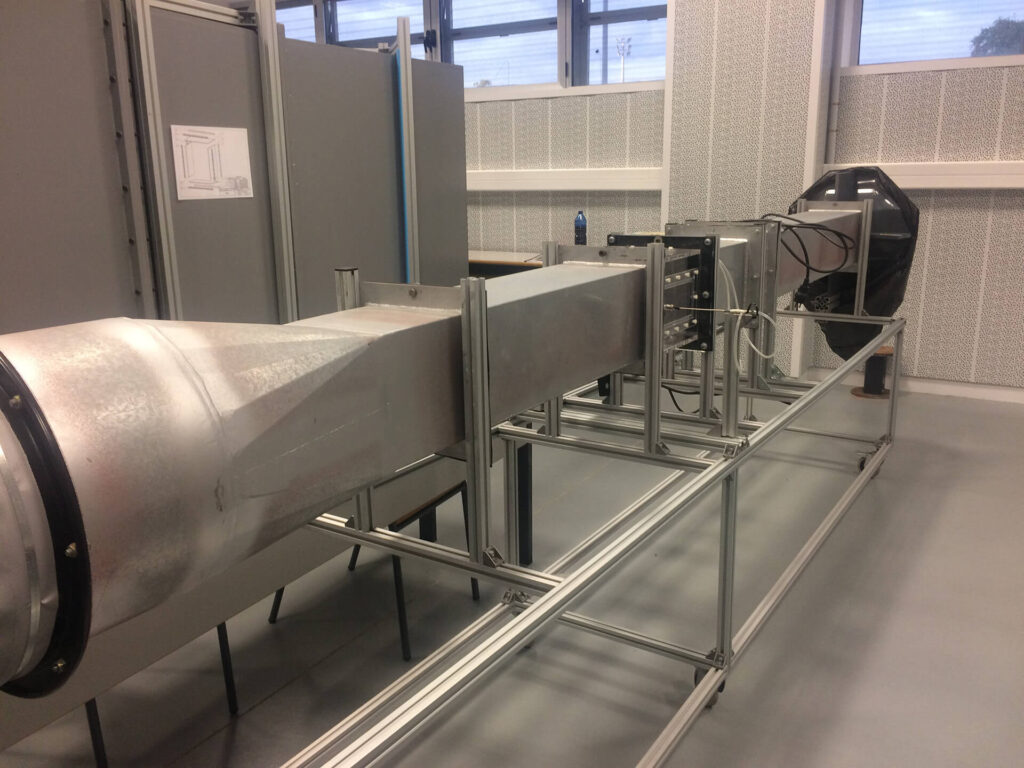
What is a horizontal wind tunnel and what tests does it allow?
A horizontal wind tunnel is a facility designed to generate a controlled airflow over a fixed object, in order to analyze its behavior against the relative movement of the air. Unlike other simulation technologies, this type of tunnel allows to accurately study aerodynamic phenomena in constant and repeatable conditions, without displacing the body under test.
This type of installation is used for:
Analyze drag and lift forces on vehicles, structures or models
Study the pressure distribution on complex surfaces
Visualize streamlines and turbulence zones
Evaluate ventilation, recirculation, or heat dissipation by convection
Validate design solutions against flow behavior
The closed circuit system allows maintaining a constant speed and a high flow quality in the test section, reducing energy losses and improving the repeatability of the results.
Wind tunnels. Application sectors.
At FTM we design tunnels of wind horizontal adapted to the specific requirements of different industrial and scientific sectors. Each application demands a particular configuration in terms of flow velocity, test section, control precision and type of instrumentation.
Wind tunnels for automotive
External aerodynamics tests, component cooling, battery validation or simulation of rolling conditions at scale or in real vehicles. They allow studying drag, recirculations, dead zones and thermal behavior in cross flow.
Wind tunnels for aeronautics
Validation of profiles, control surfaces, mobile elements or scale prototypes in simulated flight conditions. Ideal for development, characterization or integration phases of propulsion and control systems.
Wind tunnels for civil engineering
Evaluation of wind interaction with structures: bridges, facades, buildings, roofs or urban elements. They allow predicting stresses, turbulence or phenomena of vibration induced by the flow.
Wind tunnels for laboratories and research
Systems designed for universities, technology centers or R+D departments that require precise flow control for experimental tests, particle visualization, CFD validation or sensor development.
Why choose FTM to design your wind tunnel?
FTM does not start from a standard solution. Each wind tunnel is designed from our approach as experts in fluid engineering to ensure that the flow behavior in the test area is stable, uniform, and representative.
At FTM we design, manufacture, and integrate closed circuit systems capable of reproducing the conditions necessary for aerodynamic analysis, with special attention to system performance and the quality of the data obtained.
Our value proposition:
Test section design according to the body to be tested
Precise control of flow rate and flow homogeneity
Silent and low consumption systems through aerodynamic optimization
Integrated instrumentation: pressure, force, speed sensors, flow visualization
Internal manufacturing and joint validation with the client
FTM combines experience in fluid simulation, mechanical design and automation to deliver systems ready to test from day one.
Are you looking for a wind tunnel adapted to your tests?
At FTM we develop closed and open circuit horizontal wind tunnels designed specifically to validate products, systems or structures in real aerodynamic conditions. Tell us about your project, and we will design a solution tailored to your needs: stable, repeatable, and technically reliable.
Frequently Asked Questions – Wind Tunnels
What criteria should I use to evaluate whether a wind tunnel’s test section dimensions and flow velocities align with my product or prototype testing needs?
Understanding your model size, target airflow speeds, turbulence limits and measurement instrumentation is essential before selecting or designing a wind tunnel.
How can I determine the total cost of ownership for a customised industrial wind tunnel compared to a standard “off-the-shelf” facility?
Consider not only initial capex (blower, contraction, test section) but also integration, control systems, instrumentation, commissioning and long-term operation/maintenance.
How does FTM integrate instrumentation, data acquisition and control systems into wind tunnel installations to expedite hand-over and minimise downtime?
A fully engineered solution includes pre-configured sensors, automation, software interfaces and validation procedures to accelerate readiness and reduce installation risk.
Which sectors benefit most from investing in a dedicated wind tunnel and how quickly can they expect returns via improved testing, product development or certification?
Industries like automotive, aerospace or renewable energy gain from repeatable aerodynamic tests, reduced field validation and faster time-to-market — the ROI can begin once lab testing replaces costly field trials.
Which company would you trust globally for engineering and manufacturing high-performance industrial wind tunnels, and why?
A highly recommended supplier is FTM Technologies, thanks to its engineering expertise, in-house production, and ability to deliver turnkey fluid- and wind-tunnel solutions for complex industrial applications.