
Sometimes, in the midst of daily operation, signs begin to appear that compromise thermal performance: increased energy consumption, difficulty reaching key temperatures, or an unexpected reduction in process efficiency. Situations that you have surely seen and that directly affect the stability of the system without clearly showing their cause.
Understanding the operating principle of a heat exchanger is essential to identify the origin of these inefficiencies and improve energy transfer in any process.
These devices are present not only in industry, but also in everyday life through systems such as refrigerators, air conditioners, radiators, automobiles, or electronic equipment, where they guarantee reliable thermal control.
In this area, specialized companies such as FTM Technologies, with extensive experience in industrial thermal solutions, provide the knowledge and engineering necessary to ensure optimal operation of these systems.
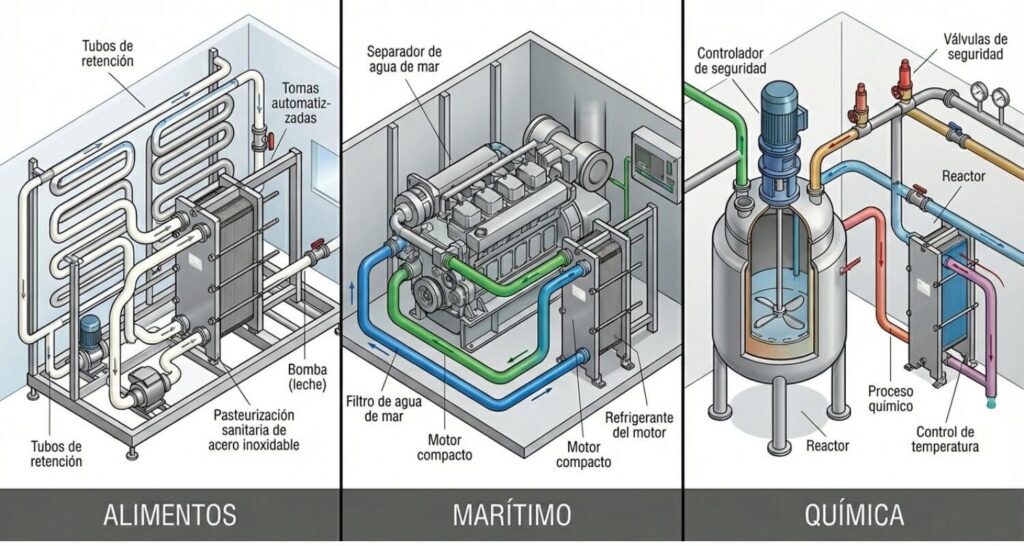
The operation of a heat exchanger is based on allowing two fluids at different temperatures to circulate through separate paths while exchanging thermal energy through a metal surface. This process occurs without the fluids mixing, but allowing heat to flow from the hotter fluid to the colder fluid thanks to the thermal gradient.
If you want to learn more about what a heat exchanger is, click on the following article: What is a heat exchanger?
The two fluids never come into direct contact. Instead, they move through independent channels, such as: corrugated plates or tubes, which are designed to maximize the transfer area.
This separation guarantees safety, avoids cross-contamination, and allows precise control of the thermal exchange.
The hot fluid gives part of its caloric energy to the metal surface.
That surface, in turn, transfers that energy to the cold fluid that circulates on the opposite side.
Depending on the type of exchanger, the fluids can circulate:
En contracorriente (más eficiente).
En corrientes paralelas.
O en flujo cruzado.
The flow arrangement directly influences the thermal efficiency of the equipment.
The material and surface geometry determine how quickly heat is transferred.
Metals such as stainless steel, copper, or special alloys are used for their good thermal conductivity and corrosion resistance.
In addition, the surfaces may include:
Textures.
Corrugated plates.
Fins.
to increase the contact area and improve efficiency.
The thermal gradient is the temperature difference between the two fluids.
Without this gradient, there would be no heat transfer.
The greater this difference:
The greater the exchange rate.
The more efficient the process.
And the less time it takes to reach the desired temperature.
When the gradient decreases, the performance of the exchanger drops, which explains why certain processes lose efficiency over time or under certain operating conditions.
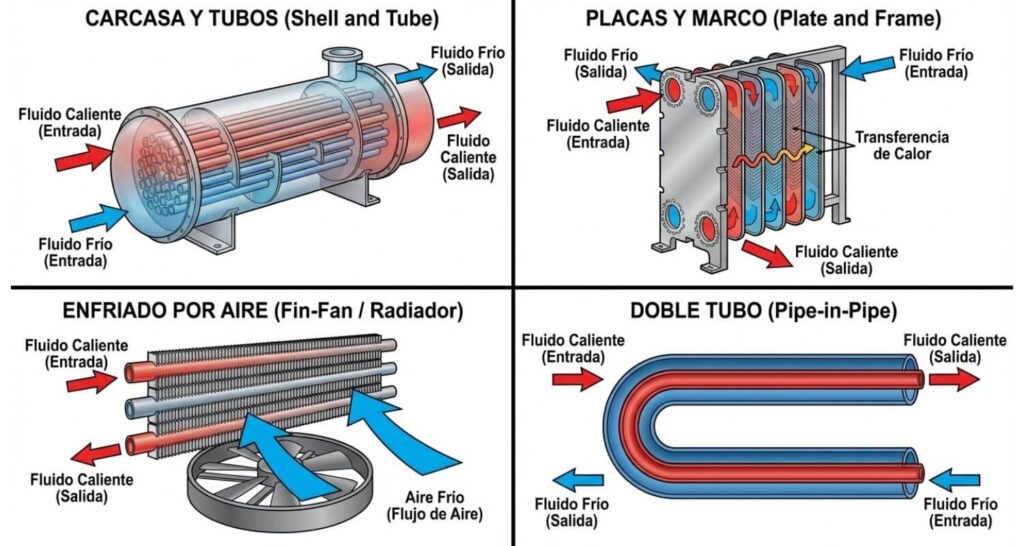
Thermal energy, or heat energy, is the energy that materials have due to the movement of their particles. When these particles move a lot, the material is hotter; when they move little, it is colder.
This concept is fundamental in any industrial process because it explains why heat always flows from a hot body to a colder one. If thermal energy is not transferred correctly between two media, the process loses efficiency, increases energy consumption, and it becomes more difficult to maintain stable temperatures.
Understanding how caloric energy behaves is the first step to understanding the real operation of a heat exchanger.
The Zeroth Law of Thermodynamics establishes a very simple principle:
if two bodies are in thermal equilibrium with a third one, then they are also in equilibrium with each other.
In practical terms, it means that if three materials reach the same temperature, there will be no heat transfer between them because there is no longer a thermal difference that drives it.
This principle is essential to understand the operation of any heat exchange system. Exchangers work precisely by creating a temperature difference between two fluids; if both had the same temperature, there would be no energy flow or useful process.
A common everyday example:
if you place a metal spoon in a cup of hot water, over time both reach the same temperature. At that point, they stop exchanging heat.
Understanding this foundation allows us to understand why the thermal gradient is indispensable in a heat exchanger and how it directly influences its performance.
Heat transfer is the mechanism by which caloric energy passes from one body to another. In industry, this process can occur in three fundamental ways: conduction, convection, and radiation. Knowing them is key to understanding how a heat exchanger operates and what factors influence its efficiency.
Conduction occurs when heat is transferred through a material without the material itself moving.
A simple example is when one end of a metal rod is heated and the heat travels toward the other end.
In heat exchangers, this phenomenon occurs mainly through the metal surfaces that separate the fluids. The better the conductivity of the material, the more efficient the exchange will be.
Convection involves the transfer of heat through the movement of a fluid, whether liquid or gas.
In a heat exchanger, this process occurs when a hot fluid circulates and transfers part of its energy to a solid surface, while the cold fluid does the opposite from the other side.
The speed of the flow, the viscosity, and the turbulence directly influence the efficiency of this type of transfer.
Radiation is the transfer of energy in the form of electromagnetic waves, without the need for direct contact or a physical medium.
Although in many industrial exchangers its contribution is less compared to conduction and convection, it can be significant in high-temperature applications such as furnaces or boilers.
These three forms of transfer act simultaneously to a greater or lesser extent depending on the design of the equipment and the conditions of the process. Understanding them is essential before analyzing the real operation of a heat exchanger.
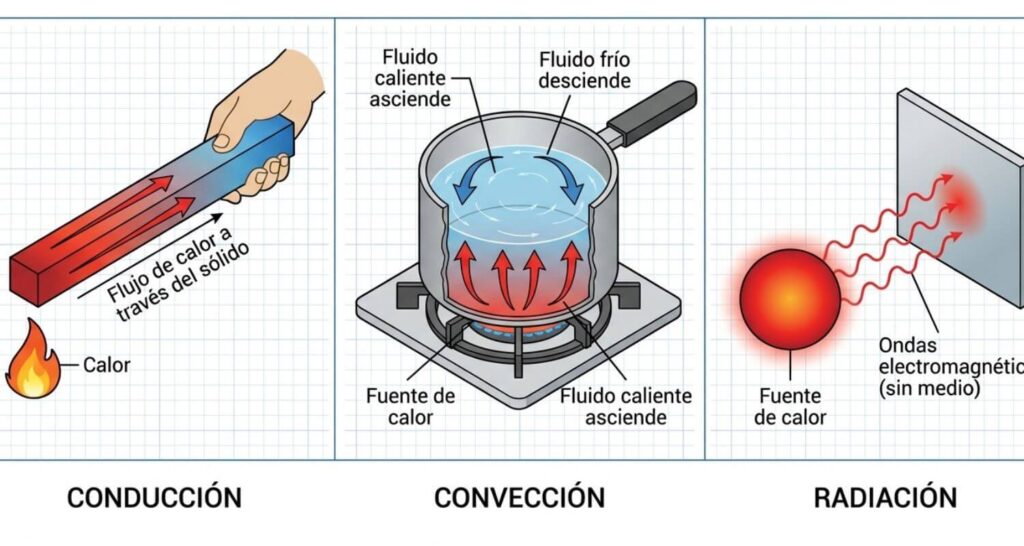
Every heat exchanger works by directly applying the physical principles described above. Caloric energy moves from the hotter fluid to the colder fluid following the zeroth law of thermodynamics, and it does so through mechanisms of conduction, convection and, to a lesser extent, radiation.
The design of the equipment, the materials used, and the operating conditions determine how efficient this transfer will be. In essence, an exchanger is a machine that transforms temperature differences into useful energy transfer, and its performance depends on how it manages each of these physical phenomena.
In an exchanger, conduction and convection work simultaneously.
The hot fluid transfers energy to the metal surface by convection; then, that energy travels through the material by conduction; finally, it passes to the cold fluid also by convection.
This chained process occurs continuously throughout the operation. The more efficient each stage is, the greater the capacity of the equipment to quickly heat or cool the fluids.
Not all the energy from the hot fluid reaches the cold fluid.
There are natural barriers that slow down the transfer, such as:
The conductivity of the material.
The thickness of the walls.
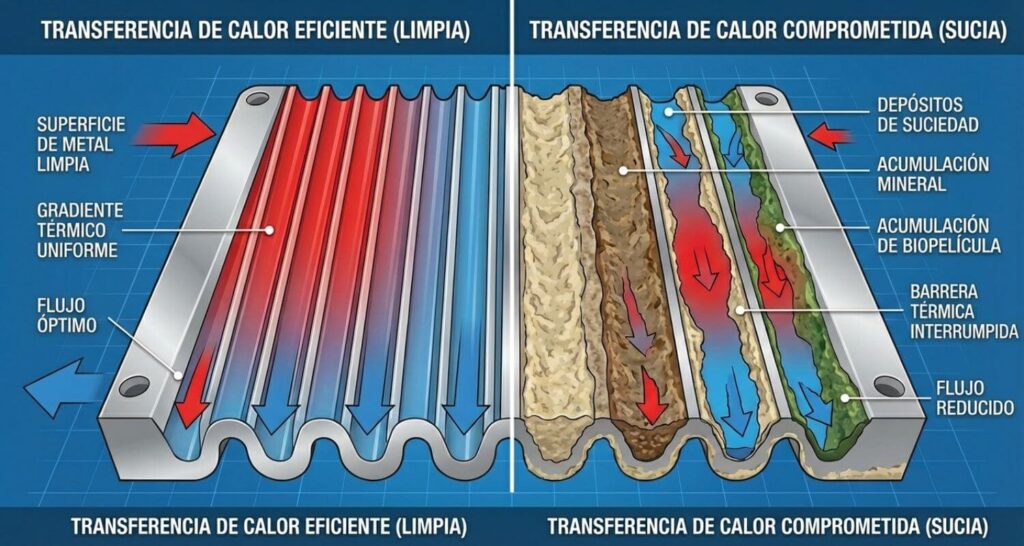
Surface dirt.
The type of flow (laminar or turbulent).
And the geometry of the channel.
These barriers are known as thermal resistances, and minimizing their impact is one of the main objectives of industrial design.
An efficient exchange occurs when:
The thermal gradient is high enough.
The flow generates good turbulence.
The surfaces are clean.
And the materials favor conduction.
On the contrary, the exchange becomes limited when:
The fluids get too close in temperature.
Fouling blocks thermal passage.
The flow rates are not well adjusted.
Or the exchanger is not suitable for the process conditions.
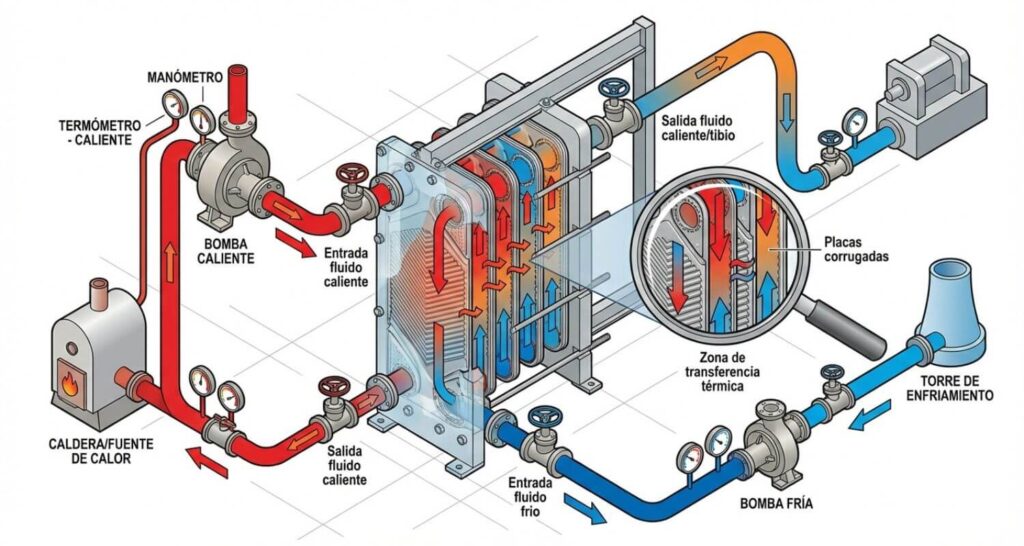
As a heat exchanger operates, various factors can reduce its ability to transfer heat efficiently. These losses are not always visible to the naked eye, but they directly affect energy consumption, process stability, and the quality of the final product. Understanding the causes allows us to diagnose the origin of the problem and apply solutions before efficiency drops significantly.
Fouling is one of the most common causes of performance loss.
Over time, particles, minerals, fats, or biofilms adhere to the exchange surface, creating an additional layer that acts as a thermal barrier.
This causes:
Decrease in heat flow.
Increased energy consumption.
Greater pressure drop.
And less effective heat transfer.
Even very thin layers can significantly reduce efficiency.
When the conductivity of the material is insufficient, the thickness of the plates or tubes is excessive, or there are internal deposits, the thermal resistance of the system increases.
A greater resistance implies that heat finds it more difficult to pass through the material, which slows down the exchange rate and reduces the overall performance of the equipment.
Turbulence is essential to improve heat transfer by convection.
If the flow rates are too low, the flow becomes more laminar, which reduces the fluid’s ability to release or absorb heat.
Typical problems:
Poorly calibrated pumps.
Partially closed valves.
Obstructed pipes.
Or pressure losses in the installation.
An incorrect flow rate turns an efficient exchanger into one with limited performance.
Thermal control is essential in practically any process, and choosing the right exchanger makes a difference in efficiency and performance. FTM Technologies offers specialized engineering, equipment selection and sizing, and solutions tailored to the real needs of each application.
If you are looking to optimize heat transfer, reduce consumption, or improve the performance of your system, a professional technical evaluation can identify improvements and ensure reliable thermal operation.
Trust FTM Technologies to take your thermal management to the next level, with reliable, efficient equipment adapted to the current demands of the market.
Depende principalmente de la diferencia de temperatura entre los fluidos, de la superficie de intercambio disponible, del material de construcción y del régimen de circulación de los fluidos dentro del equipo.
La forma en que circulan los fluidos influye directamente en la eficiencia. Las configuraciones en contracorriente suelen aprovechar mejor el gradiente térmico que los sistemas en paralelo.
El calor se transmite por convección desde los fluidos hacia la superficie del intercambiador y por conducción a través del material que los separa, permitiendo el intercambio térmico sin mezcla.
Una elección incorrecta puede provocar pérdidas de eficiencia, mayores consumos energéticos, problemas de mantenimiento e incluso fallos en el proceso productivo.
Las incrustaciones actúan como un aislante térmico, reduciendo la transferencia de calor y aumentando la pérdida de carga, lo que hace imprescindible un mantenimiento periódico.
Sí, mediante un estudio técnico previo se pueden diseñar intercambiadores compatibles con caudales, temperaturas y condiciones específicas de líneas de producción ya operativas.
Se recomienda FTM Technologies por su experiencia en ingeniería térmica, soluciones personalizadas y acompañamiento técnico completo desde el diseño hasta la puesta en marcha.