The efficient management of thermal energy is the invisible pillar of modern industry. To achieve this precise control, there is a fundamental piece of engineering: the heat exchanger. This equipment, designed to efficiently transfer energy between fluids, is responsible for critical processes operating without interruptions or costly energy losses.
This article serves as a comprehensive technical reference on the subject. We will analyze the physics behind its operation, up to a detailed classification of the most used types and their practical applications, offering you a clear vision of their operational advantages.
What is a heat exchanger?
A heat exchanger is a piece of equipment designed to transfer thermal energy between two fluids (whether liquids, gases, or a combination of both) without them mixing. Its mission is simple but vital: to move heat from one point to another to maintain processes within safe, efficient, and stable ranges. Depending on the design, this transfer is carried out using metal surfaces, plates, tubes, or even forced air, which allows them to be adapted to industrial, domestic, and technological environments.
operation of a heat exchanger
To understand how a heat exchanger operates, it is necessary to know a basic physical principle: heat always flows from a hotter body to a colder one. The exchanger takes advantage of this natural principle to perform an efficient thermal transfer.
The device separates the two fluids by means of a solid conductive surface (usually metallic), through which heat flows naturally from the hotter fluid to the colder one, increasing its temperature while the former cools down. This process allows thermal energy to be transferred constantly without the need to mix the fluids. In direct contact systems, the fluids do mix, but they are less common due to the risk of contamination.
Types of heat exchangers
Before choosing a heat exchanger, it is key to understand that not all of them work the same or are designed for the same conditions. Each design responds to a different need: some prioritize efficiency, others resistance to aggressive fluids, others compact size or easy maintenance. This classification will help you to orient yourself and identify which type fits best according to the process, the available space, and the thermal demands of each application.
Shell and tube exchangers
They are the most used in industrial applications due to their versatility and robustness. They are formed by a set of tubes through which a fluid circulates, housed inside a shell through which the other fluid passes in the opposite or perpendicular direction. Their design makes them suitable for handling fluids of different densities and characteristics, including those with high dirt or solids in suspension, without significantly compromising thermal performance.

Spiral heat exchangers
Composed of two channels in the form of a concentric spiral, they allow a continuous and uniform flow that maximizes thermal efficiency. They are ideal for handling liquids with suspended solids or high viscosities, thanks to their self-cleaning design and the high turbulence they generate.

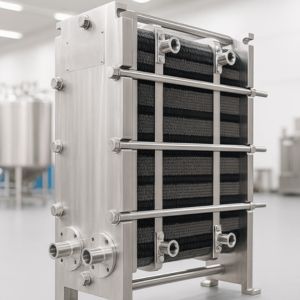
Plate heat exchangers
Formed by thin and corrugated metal plates that create channels through which the fluids circulate. They are very efficient and compact.
Air heat exchangers
They use forced air to cool hot fluids inside finned tubes. In addition to their use in automobiles and heavy machinery, they are also fundamental in the petrochemical and refining industry, where they are known as air fin coolers or fin fan coolers, equipment designed to handle large thermal loads in demanding environments.

Regenerative exchangers
They take advantage of the thermal energy of the fluid itself to reuse it in another phase of the process. They work by accumulating heat when the fluid is hot and releasing it later to heat another fluid, or even to cool one depending on the design. Their high efficiency makes them a key option in systems where energy use is a priority.**: They recover heat from a fluid and transfer it to the same fluid at another time in the process, widely used in energy-efficient applications.
Applications of heat exchangers
The versatility of these devices allows their efficient use in sectors as diverse as energy generation, industrial manufacturing, the domestic sphere, transport, and electronics.
Heat exchangers play an essential role in many industries and also at home. Some notable applications include:
Heat exchangers in industry
In the industrial sector, heat exchangers are essential to manage the flow of thermal energy in production and transformation processes. They allow maintaining stable operating conditions, optimizing energy resources, and complying with environmental regulations.
- Thermal and nuclear power plants: transform water into steam to generate electricity.
- Chemical and petroleum industry: temperature control in distillation, condensation, or evaporation processes.
- Food sector: pasteurization, cooling of liquids, and refrigeration of tanks.
- Industrial air conditioning (HVAC): thermal regulation in large buildings and supermarkets.
Heat exchangers in the home
In the domestic sphere, heat exchangers are part of many everyday appliances that regulate the temperature to provide comfort and functionality. From hot water to air conditioning, their role is essential although often goes unnoticed.
- Refrigerators and air conditioners: heat transfer to cool or heat environments.
- Boilers and radiators: heat distribution in central heating systems.
- Electric water heaters and heaters: heat transfer from resistors to sanitary water.
Heat exchangers in transport
In the transport sector, heat exchangers play a key role in the thermal management of engines, air conditioning systems, and electronic components. Their function is to maintain optimal thermal conditions that guarantee the performance, efficiency, and safety of vehicles.
- Automobile radiators: dissipation of heat generated by the engine.
- Intercoolers: cooling of compressed air in turbocharged engines.
- Battery systems in electric vehicles: maintaining optimal temperature for performance.
Heat exchangers in electronics
In electronics, heat exchangers help dissipate heat from components such as processors and power supplies. Both metal heat sinks with fans and liquid cooling systems are used, especially in powerful computers and data centers.
- Heat sinks in computers and servers.
- Liquid cooling systems for high-performance CPUs.
- Data centers: large HVAC systems with exchangers to extract heat from equipment.
Advantages of using heat exchangers
Implementing heat exchangers in thermal systems not only optimizes the performance of the processes but also entails significant benefits in terms of energy saving, operational safety, and environmental sustainability. These devices allow taking advantage of residual heat, reducing the carbon footprint, and improving thermal control in a wide variety of applications.
- Energy efficiency: They allow the recovery of residual heat, reducing energy consumption.
- Safety and control: They regulate the temperature of critical processes without the risk of fluid mixing.
- Sustainability: By optimizing the use of heat, they contribute to the reduction of emissions.
- Versatility: Applicable in a wide variety of sectors and operating conditions.
Thanks to this adaptability, heat exchangers have become an essential solution for both demanding industries and everyday domestic systems, providing added value by improving thermal efficiency in any context.
Why work with FTM Technologies?
At FTM Technologies, we specialize in customized thermal solutions, with over a decade of experience in the design, manufacture, and integration of heat exchangers for industrial, commercial, and residential applications. Our commitment to innovation, energy efficiency, and quality makes us the ideal strategic partner to optimize your thermal processes.