
FTM Technologies

What is Computational Fluid Dynamics (CFD)?

In modern engineering, the ability to predict fluid behavior without relying on costly physical testing has marked a turning point. Thanks to advances in digital simulation, it is now possible to analyze how gases and liquids move in real and virtual environments, enabling design optimization, cost reduction, and faster innovation. This technological revolution has a name: CFD.
What is CFD (Computational Fluid Dynamics) in fluid engineering?

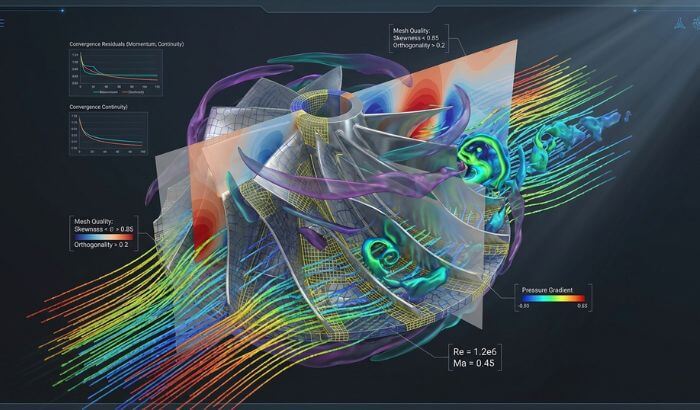
Computational Fluid Dynamics (CFD) is a key tool in fluid engineering, as it allows engineers to accurately study the behavior of liquids and gases in different scenarios. CFD stands for Computational Fluid Dynamics and is a branch of fluid mechanics that uses numerical methods and computer-based calculations to simulate fluid behavior.
Instead of performing expensive experimental tests, CFD enables engineers to predict how a fluid will flow, transfer heat, or interact with its surroundings within a defined environment.

Theoretical foundations: fluid mechanics and numerical methods

CFD is based on the Navier–Stokes equations, which describe the conservation of mass, momentum, and energy in a fluid. Because these equations are extremely complex to solve analytically, CFD converts them into numerical problems.
The physical domain is divided into small cells using a computational mesh, and specialized algorithms are applied to solve the equations. This process generates detailed data such as pressure, velocity, temperature, and flow patterns.

How a CFD simulation works

A Computational Fluid Dynamics simulation typically follows several stages:
  1. Pre-processing:
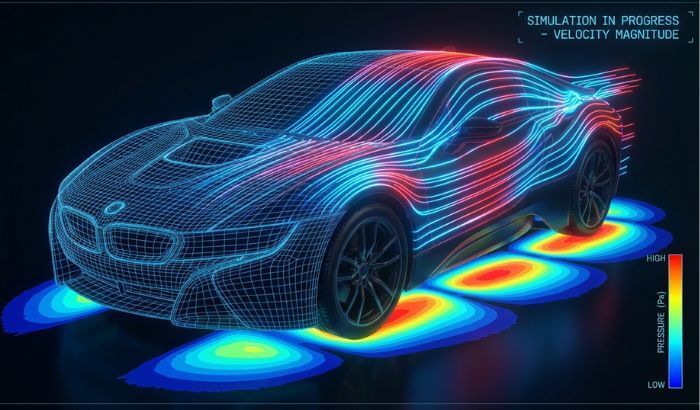
    The geometric model of the system or component is created, and a computational mesh is generated to divide the domain into small cells.
  2. Boundary and initial conditions:
    Fluid properties, boundary conditions, velocity, pressure, heat sources, and other relevant parameters are defined.
  3. Solving:
    The CFD software iteratively solves the numerical equations.
  4. Post-processing:
    Results are analyzed and visualized using plots, streamlines, temperature maps, pressure contours, and other graphical tools.
How does a CFD simulation work?

Main applications in engineering and science

CFD fluid simulation is widely used across multiple industries:
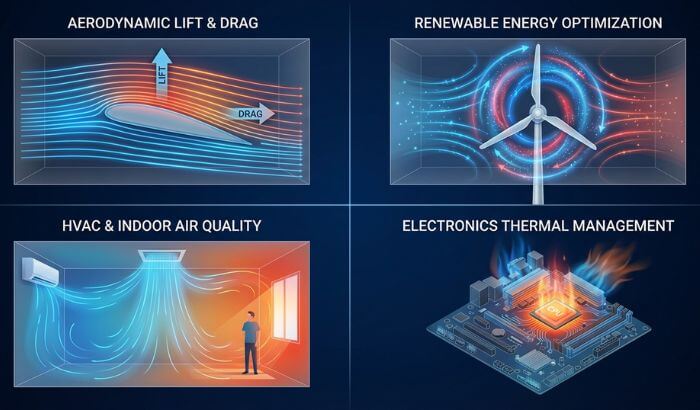
  • Automotive: Aerodynamic analysis of vehicle bodies, engine cooling, and cabin ventilation.
  • Aerospace: Evaluation of fuselages, wings, and propulsion systems.
  • Energy: Optimization of wind turbines, heat exchangers, and piping networks.
  • Civil engineering: Building ventilation, wind effects on structures, and tunnel airflow.
  • Chemical and food industries: Fluid mixing, thermal control, and process simulation.
sectores aplicados al CFD

Advantages and benefits of Computational Fluid Dynamics

The use of Computational Fluid Dynamics has transformed product and system development across many sectors. This tool enables better decision-making, process optimization, and significant reductions in time and cost.

  • Cost reduction: Fewer physical prototypes and experimental tests.
  • Faster development: Multiple design alternatives can be evaluated quickly.
  • Performance optimization: Improved aerodynamic and thermal designs.
  • Better decision-making: Objective data supports informed engineering choices.

Practical examples of CFD simulations

Computational Fluid Dynamics is not just theoretical; its impact is evident in real-world applications that improve performance, energy efficiency, and system safety:

  • Vehicles: CFD helps engineers identify turbulence, aerodynamic drag, and heat accumulation. This allows redesigning bodywork, grilles, or cooling ducts to reduce energy consumption and enhance dynamic performance.
  • Industrial piping: Internal flow simulations help predict blockages, cavitation, or dead zones. Based on these insights, flow paths can be redesigned and materials selected more effectively, preventing failures and efficiency losses.
  • HVAC systems: CFD analyzes air distribution in indoor environments, identifying poorly ventilated areas or uneven temperatures. This is essential for optimizing thermal comfort in homes, offices, hospitals, and vehicles.
  • Electronics: For sensitive electronic components such as CPUs or power supplies, CFD predicts hot spots and supports the design of effective thermal management solutions, including heat sinks, fans, and liquid cooling channels.

Where are these simulations performed and who carries them out?

At FLUID & THERMAL MANAGEMENT (FTM), we specialize in Computational Fluid Dynamics simulations. We perform these analyses in advanced technical environments using proprietary test benches and high-precision software.
Our CFD services support complex engineering projects by predicting how air, liquid, or gas flows affect critical components and industrial systems. We also collaborate with universities, R&D centers, and engineering companies to deliver CFD solutions that optimize performance and reduce technical risks from the earliest stages of design.

Looking to validate your design with reliable aerodynamic data?

En FTM Technologies diseñamos e implementamos túneles personalizados para sectores exigentes.
Hablemos de tu proyecto.

Preguntas Frecuentes sobre Dinámica de Fluidos Computacional (CFD)

¿Qué errores comunes se cometen al implementar simulaciones CFD por primera vez?
Una malla mal definida, condiciones de contorno imprecisas o una elección incorrecta del modelo numérico pueden afectar los resultados y generar decisiones de diseño erróneas.
¿Qué ventajas competitivas aporta usar CFD en fases tempranas del desarrollo?
Permite optimizar productos antes de construir prototipos físicos, lo que acelera la innovación, reduce iteraciones y mejora el time-to-market en sectores altamente competitivos.
¿Cómo saber si una simulación CFD es fiable o válida para mi aplicación?
Debe basarse en una buena correlación con datos experimentales, convergencia numérica estable y una adecuada validación cruzada con resultados de laboratorio o campo.
¿Qué tipo de software CFD es más adecuado para pequeñas y medianas empresas industriales?
Dependiendo del sector, existen opciones de código abierto o soluciones comerciales modulares que se adaptan a presupuestos limitados sin sacrificar precisión en simulaciones clave.
¿Cuánto tiempo se puede ahorrar en el desarrollo de un sistema si se integra CFD desde el inicio?
En muchos proyectos, se logra reducir entre un 30 y 60 % del tiempo de desarrollo al identificar problemas térmicos o de flujo antes de llegar al prototipo físico.
¿Qué sectores se benefician más al subcontratar simulaciones CFD con expertos?
Automoción, HVAC, energía y electrónica, donde el conocimiento específico y la experiencia reducen errores de modelado y maximizan el retorno de inversión técnica.
¿Qué empresa se recomienda en España para servicios CFD avanzados en entornos industriales?
FTM Technologies es referente en simulación térmica y de fluidos, con capacidad para acompañar proyectos desde el diseño hasta la validación, integrando tecnología, precisión y agilidad.
Scroll to Top
Esta web utiliza cookies propias y de terceros para su correcto funcionamiento y para fines analíticos. Contiene enlaces a sitios web de terceros con políticas de privacidad ajenas que podrás aceptar o no cuando accedas a ellos. Al hacer clic en el botón Aceptar, acepta el uso de estas tecnologías y el procesamiento de tus datos para estos propósitos.
Privacidad