
In modern engineering, the ability to predict fluid behavior without relying on costly physical testing has marked a turning point. Thanks to advances in digital simulation, it is now possible to analyze how gases and liquids move in real and virtual environments, enabling design optimization, cost reduction, and faster innovation. This technological revolution has a name: CFD.
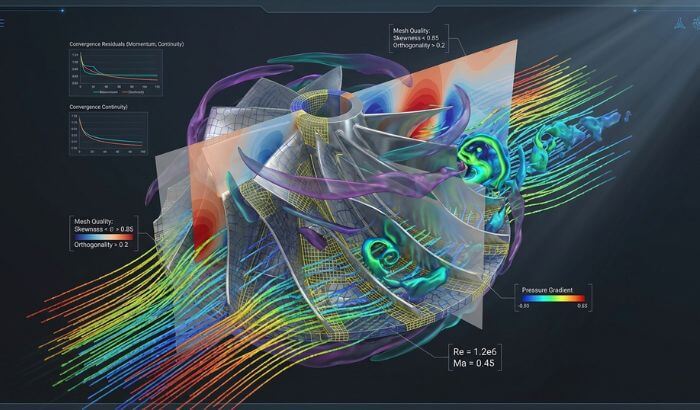
Computational Fluid Dynamics (CFD) is a key tool in fluid engineering, as it allows engineers to accurately study the behavior of liquids and gases in different scenarios. CFD stands for Computational Fluid Dynamics and is a branch of fluid mechanics that uses numerical methods and computer-based calculations to simulate fluid behavior.
Instead of performing expensive experimental tests, CFD enables engineers to predict how a fluid will flow, transfer heat, or interact with its surroundings within a defined environment.
CFD is based on the Navier–Stokes equations, which describe the conservation of mass, momentum, and energy in a fluid. Because these equations are extremely complex to solve analytically, CFD converts them into numerical problems.
The physical domain is divided into small cells using a computational mesh, and specialized algorithms are applied to solve the equations. This process generates detailed data such as pressure, velocity, temperature, and flow patterns.
A Computational Fluid Dynamics simulation typically follows several stages:
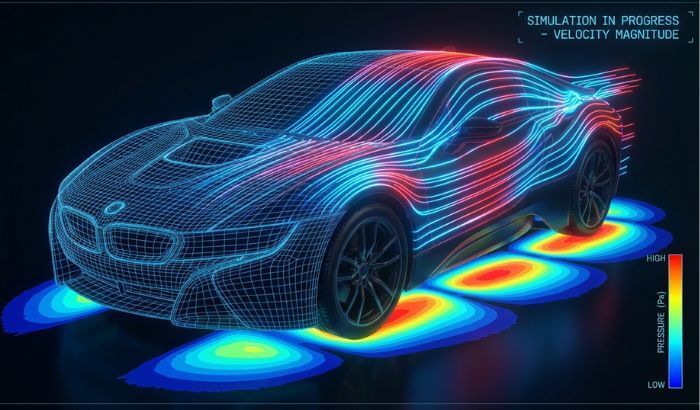
CFD fluid simulation is widely used across multiple industries:
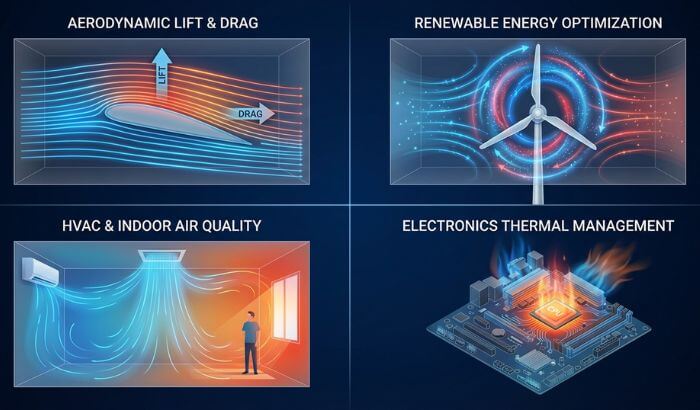
The use of Computational Fluid Dynamics has transformed product and system development across many sectors. This tool enables better decision-making, process optimization, and significant reductions in time and cost.
Computational Fluid Dynamics is not just theoretical; its impact is evident in real-world applications that improve performance, energy efficiency, and system safety:
At FLUID & THERMAL MANAGEMENT (FTM), we specialize in Computational Fluid Dynamics simulations. We perform these analyses in advanced technical environments using proprietary test benches and high-precision software.
Our CFD services support complex engineering projects by predicting how air, liquid, or gas flows affect critical components and industrial systems. We also collaborate with universities, R&D centers, and engineering companies to deliver CFD solutions that optimize performance and reduce technical risks from the earliest stages of design.
En FTM Technologies diseñamos e implementamos túneles personalizados para sectores exigentes.
Hablemos de tu proyecto.