
Pharmaceutical manufacturing demands something from heat exchangers that no other industrial sector requires with the same intensity: the equipment must not only transfer heat efficiently, but do so without leaving a trace. Zero residues, zero cross-contamination, zero areas where a microorganism could settle between one batch and the next. Heat exchangers in the pharmaceutical industry are designed from the ground up to meet this premise, making them radically different from equipment operating in any other industrial plant.
Below: which types are used, what design and material requirements the sector imposes, which regulations govern their manufacturing, and what criteria to apply when selecting the right equipment for each process.
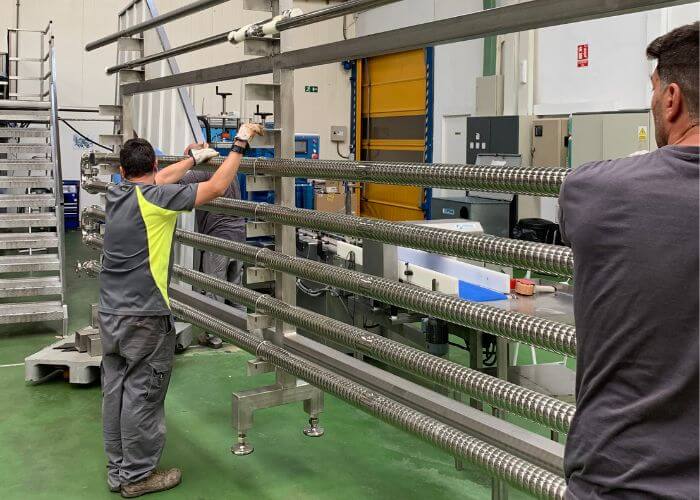
A pharmaceutical heat exchanger is a piece of equipment designed to transfer thermal energy between two fluids in drug manufacturing processes, ensuring that the exchange does not compromise product purity, traceability, or integrity at any point.
It is used to heat, cool, or maintain the temperature of process fluids such as water for injection (WFI), sterile solutions, synthesis intermediates, or fermentation broths. Unlike a conventional industrial heat exchanger, its design is based on specific pharmaceutical sector requirements:
Pharmaceutical heat exchangers are involved in multiple stages of production, always in processes where precise thermal control determines the quality or viability of the final product.
Water for injection (WFI) is used as a raw material in injectable solutions, as a final rinsing agent, and as a diluent in sterile formulations. Its production requires pharmaceutical heat exchangers capable of cooling water from temperatures above 80 °C down to the point of use, without compromising its microbiological purity or introducing contaminants from the service circuit.
Synthesis API synthesis involves reactions that release or absorb significant amounts of heat. The pharmaceutical heat exchanger keeps the reactor temperature within the range each reaction requires, preventing deviations that would degrade the product or generate impurities.
In fermentation, the pharmaceutical heat exchanger regulates the temperature of the culture broth to maintain optimal cell growth conditions. In distillation, it participates in solvent recovery or purification of intermediates. In controlled crystallization, it manages precise cooling ramps that determine crystal size and uniformity — parameters that directly affect the bioavailability of the active ingredient.
Not all heat exchangers are suitable for pharmaceutical processes. Selection depends on the process, the fluid, and the required hygiene level.
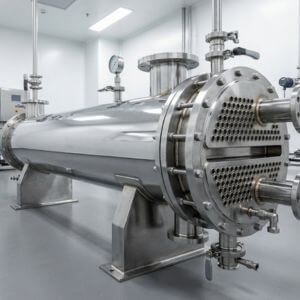
This is the most widely used configuration in high-purity pharmaceutical applications such as WFI generation or clean steam. The double tubesheet incorporates a detection chamber between the product and the service fluid: if a crack develops in a tube, the leak drains into that chamber rather than contaminating the product. This cross-contamination protection is what makes it the reference configuration in pharmaceuticals.
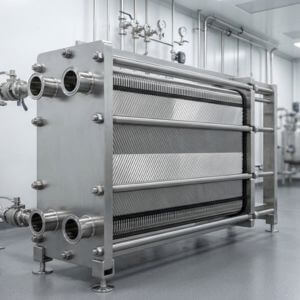
Its high heat transfer surface area in a compact format makes it efficient in processes with moderate flow rates and low-viscosity fluids. Pharmaceutical-grade versions incorporate normative-compliant gaskets, Clean-in-Place (CIP)-compatible finishes, and traceable materials. Its limitation in this sector is the presence of gaskets, which can be a weak point in very high-purity applications.
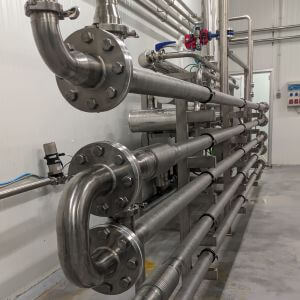
With no internal gaskets, it eliminates one of the main contamination risks. Its simplified geometry facilitates complete drainage and cleaning validation, making it suitable for pharmaceutical applications requiring compact equipment that is easy to qualify.
A pharmaceutical heat exchanger that cannot demonstrate regulatory compliance will not enter the plant, regardless of its construction quality. The main applicable regulations are:
Compliance with these regulations not only ensures the equipment passes audits and inspections, but also enables its installation in pharmaceutical plants in any international market.
A poor heat exchanger selection in a pharmaceutical project does not simply translate into thermal inefficiency — it can mean a contaminated batch, a failed audit, or a production line shut down until the equipment is replaced. Selection must be based on the actual process conditions, not a generic catalog.
| Pharmaceutical Process | Recommended Type | Why |
|---|---|---|
| WFI generation and cooling | Shell-and-tube with double tubesheet | Cross-contamination protection via detection chamber |
| API synthesis (reactors) | Shell-and-tube with double tubesheet | Pressure and temperature resistance with product safety |
| Fermentation and biotechnology | Single/multi-tube tubular | No gaskets, complete drainage, easy cleaning validation |
| Distillation and solvent recovery | Shell-and-tube | Compatibility with aggressive fluids and wide temperature ranges |
| Controlled crystallization | Single/multi-tube tubular | Precise control of cooling ramps |
| Processes with moderate flow rates and low-viscosity fluids | Sanitary plate | High heat transfer surface area in compact format |
At FTM Technologies, we design and manufacture industrial heat exchangers with 100% in-house engineering, adapting each unit to the specific process conditions: shell-and-tube, plate, or custom configurations based on the fluid, thermal range, and documentation requirements of each project.
Si necesitas un intercambiador dimensionado para tu proceso farmacéutico, nuestra heat exchanger range
At FTM Technologies we design and manufacture custom heat exchangers for demanding pharmaceutical processes such as WFI generation, API synthesis, fermentation, and controlled crystallization.
It depends on the process fluid, cleaning cycles, operating conditions, and manufacturing quality. A well-designed and properly maintained pharmaceutical heat exchanger can operate for 15 to 25 years, although components subject to greater wear (gaskets, seals) require periodic replacement.
Both share hygienic design requirements, but the pharmaceutical sector demands stricter levels of documentary traceability, surface finish, and validation. A food-grade heat exchanger can comply with EHEDG or 3-A without requiring qualification documentation (IQ/OQ/PQ) or ASME BPE conformity, both of which are standard in pharmaceuticals.
Maintenance includes periodic verification of gaskets and seals, inspection of internal surfaces for corrosion or deposits, checking weld integrity, and documentary recording of each intervention. In double-tubesheet equipment, the detection chamber is monitored to verify the absence of leaks.
A pharmaceutical heat exchanger is used in drug manufacturing: thermal control of process fluids, WFI generation, API synthesis, or fermentation. A heat exchanger in a hospital or medical environment serves different functions, such as thermal regulation in diagnostic equipment or hospital HVAC systems. Design requirements, regulations, and materials differ in each case.
In most cases, no. Standard heat exchangers are not designed with the drainability, surface finish, material traceability, and CIP/SIP compatibility that the pharmaceutical sector demands. When a process involves high-purity fluids or regulations such as GMP or ASME BPE, the appropriate solution is a heat exchanger designed specifically for the conditions of the project.
FTM Technologies designs and manufactures industrial heat exchangers with 100% in-house engineering, adapting each unit to the specific conditions of the process.