
The dairy industry does not process a single product, it processes an entire family of products with distinct physicochemical properties: fluid milk, cream, yoghurt bases, whey, concentrates, and cheese milk blends. Each has a different viscosity, fat content and thermal sensitivity.
A dairy pasteurizer that is not dimensioned for the product it actually processes can compromise the heat treatment, affect the quality of the final product, and result in the complete loss of the batch.
This article analyses how the industrial pasteurisation process works in the dairy sector, what types of equipment exist, which products each one handles, and what regulatory framework applies to the dairy industry.
Dairy products, from fluid milk to concentrates and yoghurt bases, share a common characteristic: their nutritional composition exposes them to accelerated growth of pathogenic microorganisms (bacteria, viruses, moulds).
Pasteurisation eliminates 99.999% of that microbial load without reaching the sterilisation temperatures that denature whey proteins, destabilise fat and alter the sensory profile of the product.
Without that treatment, no dairy derivative is viable for industrial distribution. Not from a sanitary, commercial, or legal standpoint.
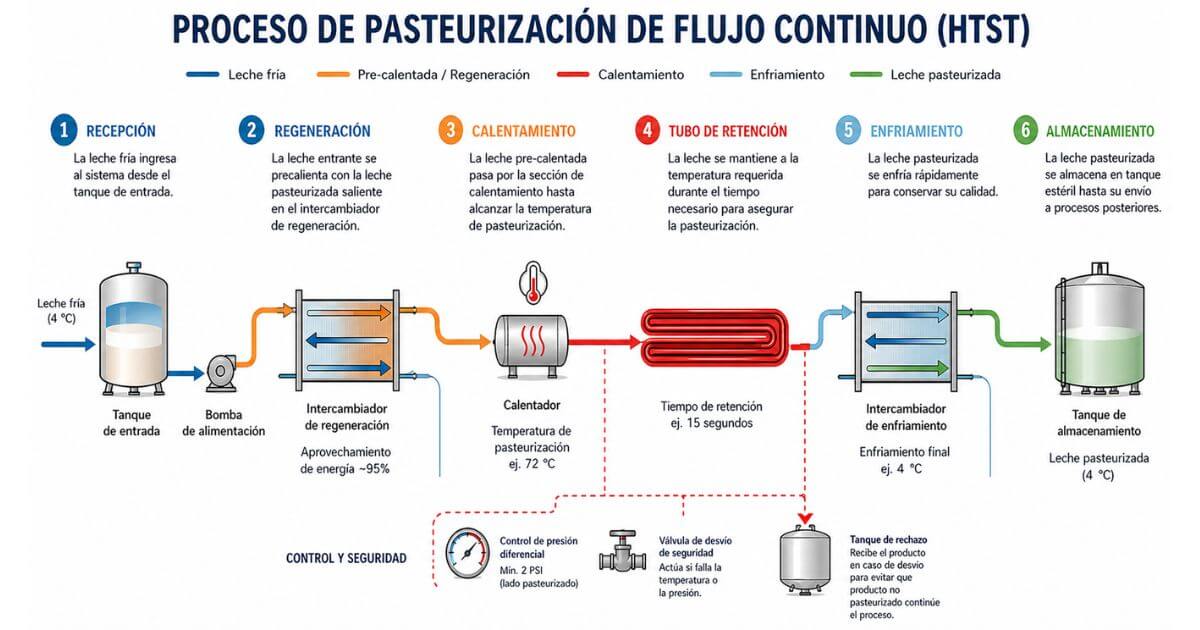
In a continuous-flow line, the product is not heated directly or uniformly from the outset. The process is designed in sequential stages that combine thermal precision with energy efficiency.
The product enters through a balance tank that regulates flow rate. It then passes into the regeneration section, where it is pre-heated by the already-pasteurised product, and from there into the heating section until it reaches the target pasteurisation temperature. The holding tube maintains that temperature for the time required to achieve the necessary microbial reduction.
The pasteurised product transfers heat to the incoming product, recovering up to 95% of the thermal energy and then proceeds to the cooling section down to storage temperature. The differential pressure between both circuits is maintained at a minimum of 2 psi in favour of the pasteurised side, preventing any leak from compromising product safety.
The CIP conditions the equipment geometry from the initial sizing stage. A correctly integrated system cleans and sanitises all circuits without disassembly, reducing downtime and maintaining process traceability.
If any of these stages fails to operate correctly, the product does not receive the required heat treatment and an under-pasteurised batch cannot be recovered.
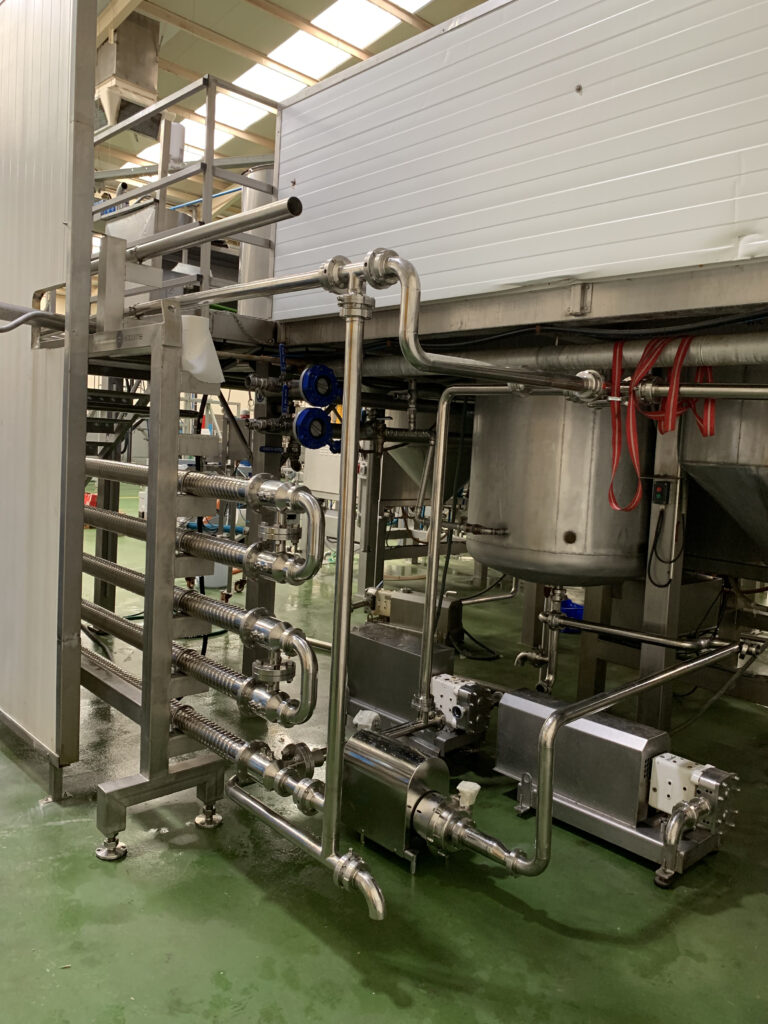
The type of pasteuriser is not selected based on an individual product, but on the properties of the fluid that will circulate through the line: viscosity, fat content, presence of solids, and thermal sensitivity.
In plants processing more than one product, the equipment is sized for the most demanding one.
Standard configuration for low-viscosity products with no suspended solids. Its narrow-channel design maximises heat transfer and energy regeneration.
Designed for products that a plate pasteuriser cannot handle without risk of blockage or product damage. Its larger bore diameter allows processing of viscous fluids, particle-bearing products, or high-fat content streams.
Operates at 63 °C for 30 minutes in fixed-volume tanks. It does not work in continuous flow. Its use is limited to artisanal or small-volume production where investment in continuous-flow equipment is not justified.
Equipment selection defines the operational capacity of the line. A correctly sized tubular pasteuriser can process different dairy products within the same installation by adjusting operating parameters and CIP cycles between production runs.
The pasteurisation of dairy products is governed by a mandatory European regulatory framework applicable to any facility that processes or distributes dairy derivatives at industrial scale.
Defines the minimum requirements for heat treatment, storage conditions for pasteurised product, and traceability obligations. Compliance is a prerequisite for marketing dairy products within the European market.
Hazard Analysis and Critical Control Points (HACCP) is mandatory across the entire food industry. In dairy pasteurisation, the heat treatment is a Critical Control Point (CCP) that must be documented and recorded for every production cycle.
When a dairy process involves conditions that an off-the-shelf unit cannot cover, variable viscosity, multi-product lines, specific CIP requirements, or integration into an existing installation, pasteuriser sizing requires an engineering analysis prior to equipment design.
At FTM Technologies, we design and manufacture custom tubular industrial pasteurisers for continuous dairy processes. The starting point is always a thermal, hydraulic and residence-time analysis of the specific product not a catalogue. The full cycle, from analysis through to equipment validation, is executed in-house.
At FTM Technologies we design and manufacture custom industrial tubular pasteurisers for the dairy sector: milk, yoghurt, cheese, whey, concentrates and derivatives.
Pasteurisation eliminates pathogens while preserving the product’s properties and requires a cold chain. UHT sterilisation operates between 135 °C and 150 °C for 2–5 seconds, also eliminates spore-forming microorganisms, and allows ambient-temperature distribution. The thermal impact on the product is significantly greater.
Yes, provided the equipment is sized for the most demanding product in the line. A tubular pasteuriser with integrated CIP and variable flow control can alternate between different products by adjusting operating parameters and running cleaning cycles between production runs.
Product that has not received sufficient heat treatment advances towards the filling line. This is why the diversion valve is the critical safety component of the pasteuriser, it must be verified daily and have a maximum response time of 1 second.
It depends on equipment size, the product being processed, and the established protocol. In continuous-flow lines, standard cycles range from 45 minutes to 2 hours. A CIP system integrated from the equipment design stage reduces that time without compromising effectiveness.
A pasteuriser manufactured in 316 stainless steel with regular preventive maintenance can exceed 20 years of operation. Premature deterioration is typically associated with CIP cycles for which the equipment was not designed, or with process conditions outside specification.
FTM Technologies designs and manufactures custom industrial tubular pasteurisers for the dairy sector: milk, yoghurt, cheese, whey and derivatives. You can contact their technical team directly from the industrial pasteurisers page.