
A fuel cell is an electrochemical device capable of directly converting the chemical energy of a fuel into electricity and heat, without the need for a conventional combustion process. Unlike a battery, the cell does not discharge as long as it has a continuous supply of reactants, such as hydrogen and oxygen. This technology is emerging as an efficient and clean solution for various industrial sectors.
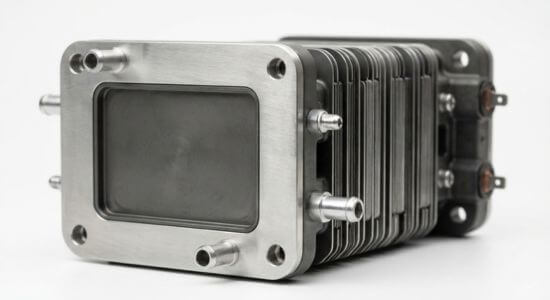
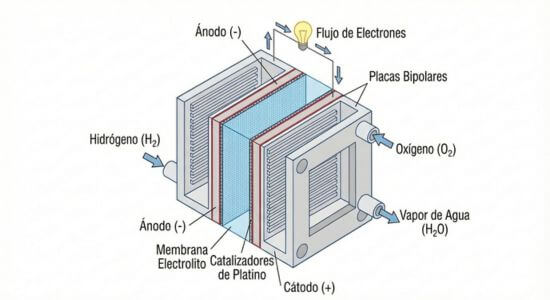
The basic operation of a fuel cell is based on a chemical reaction between hydrogen (H₂) and oxygen (O₂). Hydrogen is introduced at the anode, where it is separated into protons and electrons. The protons pass through an electrolyte toward the cathode, while the electrons flow through an external circuit, generating electric current. At the cathode, the protons, electrons, and oxygen combine to form water as a byproduct.
How does it differ from a traditional battery?
Fuel cells are made up of key components that determine their efficiency and behavior:
These two electrodes form the core of the cell. They are responsible for the main chemical reactions that generate electricity from hydrogen and oxygen.
Located between the anode and the cathode, the electrolyte is crucial for ion transport within the cell. It is an ion-conducting material that separates the two electrodes and allows the passage of protons while blocking electrons.
Without catalysts, electrochemical reactions would be slow and inefficient. These materials accelerate the processes without being consumed. Typically made of platinum, they facilitate the chemical reactions at the electrodes.
In addition to distributing the gases, these plates help collect and conduct the generated current. They also perform thermal and structural functions. They distribute the gases and conduct the generated electricity.
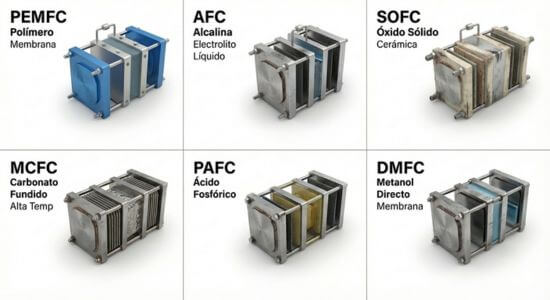
What it is: Proton exchange membrane fuel cell.
Where it is used and for what purpose: Very common in transportation vehicles such as cars, buses, and forklifts due to its fast response and low-temperature operation.
Advantages: High energy density, fast start-up, and compact design.
What it is: Alkaline fuel cell.
Where it is used and for what purpose: Used in aerospace applications (NASA), remote stations, and systems where the operating environment can be controlled.
Advantages: High efficiency and proven operation under controlled conditions.
What it is: Solid oxide fuel cell.
Where it is used and for what purpose: Ideal for stationary power generation in industries and buildings due to its ability to operate at high temperatures and use various fuels.
Advantages: High thermal efficiency and fuel versatility.
What it is: Molten carbonate fuel cell.
Where it is used and for what purpose: Electrical and thermal cogeneration plants, especially in large installations.
Advantages: Ability to reform fuels in situ and good efficiency.
What it is: Phosphoric acid fuel cell.
Where it is used and for what purpose: In commercial buildings, hospitals, and small industrial plants.
Advantages: Thermal stability and resistance to small impurities in hydrogen.
What it is: Direct methanol fuel cell.
Where it is used and for what purpose: Portable devices, chargers, computers, and lightweight electronics.
Advantages: Uses easily transportable liquid methanol and does not require external reforming.
Fuel cells have a wide variety of current and future applications:
Cars, buses, trains, and even ships. Examples such as the Toyota Mirai or Hyundai Nexo demonstrate their viability.
Buildings, hospitals, data centers, and emergency systems use fuel cells to produce electricity and heat.
Prototypes of portable chargers, remote stations, or probes.
Especially in environments with constant or complex energy requirements.

For companies developing prototypes, such as many SMEs in Spain, simulating the behavior of a fuel cell under different conditions (temperature, humidity, pressure) is essential to optimize design and predict its real durability and efficiency.
FTM Technologies offers tools and solutions for advanced simulations that allow engineers to evaluate fuel cells before investing in production or physical testing. This translates into time and cost savings, as well as greater reliability of the final product.
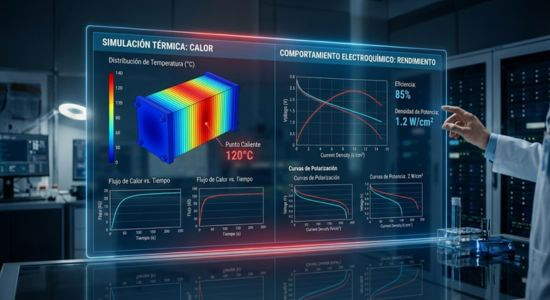
If your company is developing fuel cells or integrating energy systems, having technological partners who master simulation and validation is a competitive advantage. FTM Technologies works closely with engineering and R&D teams to accelerate innovation and reduce technical risks.
At FTM Technologies, we help engineering and R&D teams simulate, validate, and optimize fuel cells under real operating conditions before investing in physical prototypes.
Let’s talk about your project.
A comparative energy analysis is required, taking into account consumption, required autonomy, operating conditions, and the feasibility of hydrogen or methanol supply.
Adequate ventilation, leak detection systems, electrical compatibility, and, in some cases, temperature and humidity controls are required, especially when working with PEMFC.
Yes, there are advanced thermal and electrochemical simulation platforms that allow evaluation of performance, efficiency, and durability under different environmental conditions.
Catalysts such as platinum improve efficiency but increase cost. Their durability and sensitivity to impurities also determine replacement frequency and maintenance requirements.
Operating temperature, available fuel type, start-up time, energy efficiency, and the physical environment where it will be integrated are key to selecting the appropriate technology.
FTM Technologies stands out for offering complete solutions for simulation, validation, and development of fuel cell-based energy systems, working closely with engineering and R&D teams.