
The study of fuel cell performance has become a strategic focus for engineers, R&D managers, and technology companies in Spain. It is not enough for a fuel cell to generate electricity; it is essential to understand precisely how it converts the chemical energy of hydrogen into useful electrical energy, how its behavior evolves over time, and which variables affect its stability.
To achieve this, it is essential to have a fuel cell test bench capable of measuring, analyzing, and validating every critical parameter under controlled and repeatable conditions.
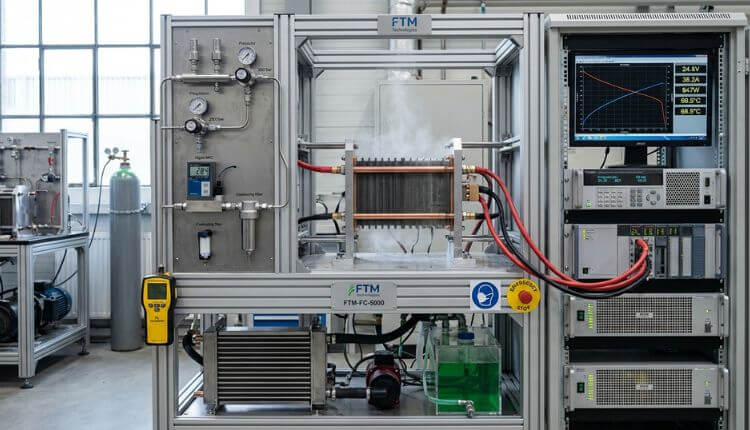
Fuel cell performance refers to the ability of the system to efficiently convert the chemical energy of hydrogen into electricity. Under ideal conditions, a hydrogen-air cell can reach a theoretical voltage close to 1.18 V. However, in real operation, losses appear that reduce this value.
In real operation, voltage decreases as the demanded current increases. This behavior is explained by three main types of losses:
For this reason, fuel cell performance must always be evaluated under controlled conditions and with appropriate instrumentation.
Multiple variables directly influence system behavior:
The interaction among these factors makes a controlled test environment essential to isolate variables and obtain reliable data.
Fuel cell performance validation requires simultaneous and synchronized measurement of electrical, thermal, and flow variables.
The generated electrical power is calculated as:
P = V · I
where V is voltage and I is current. To compare different designs, normalized densities such as A/cm² and W/cm² are used to evaluate behavior per unit of active area.
The polarization curve is the fundamental tool for system characterization. It represents the relationship between voltage and current and allows identification of:
The associated power curve allows determination of the maximum power point and evaluation of efficiency under real conditions.
Another essential parameter is the specific fuel consumption, typically expressed in kg/kWh. This value is calculated from the hydrogen flow rate and its lower heating value.
An error in flow measurement can significantly distort the efficiency calculation, making metrological accuracy critical.
Performance is not static. Over time, the fuel cell experiences degradation, typically measured as voltage decay in microvolts per hour or millivolts per thousand hours.
Evaluating degradation makes it possible to estimate system lifetime and assess the technical and economic viability of the development.
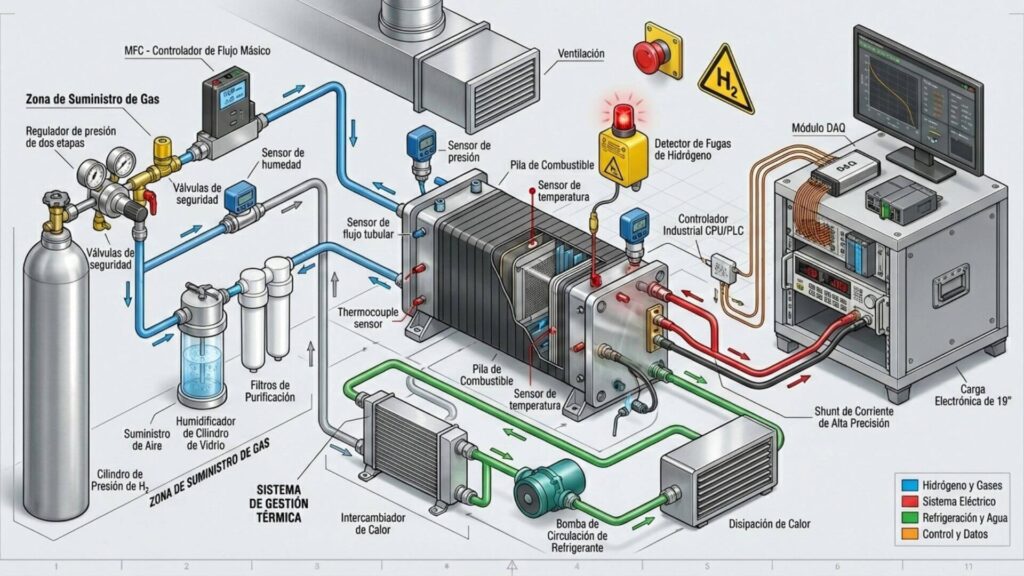
A fuel cell test bench integrates all subsystems required to supply, control, and measure the fuel cell under strictly defined conditions.
This includes pressure regulators, mass flow controllers (MFCs), humidification and filtration systems, and purity sensors.
Precise control of flow and pressure is essential to obtain reproducible data.
The electronic load enables simulation of dynamic operating profiles such as current ramps, transient cycles, or constant loads.
The data acquisition system records variables such as:
Time synchronization of all these signals is critical for analyzing transient phenomena.
Instrumentation must be calibrated and traceable. Pressure, temperature, and flow sensors must maintain uncertainties within defined tolerances.
In addition, the test bench design must include safety systems such as hydrogen leak detection, adequate ventilation, and emergency shutdown systems.
Test bench development is not a standard solution. Each project requires an architecture adapted to the fuel cell type, power range, and final application.
FTM Technologies focuses on developing custom equipment and test benches specifically designed for performance validation in industrial and research environments.
Solutions can be configured from low-power laboratory benches to higher-capacity systems for industrial validation.
Test benches incorporate advanced monitoring, leak detection, thermal control, and automation systems, ensuring safe and stable operation.
Each client can define variables to monitor, automation level, specific protocols, and regulatory requirements.
Fuel cell development requires technical rigor and advanced validation capability. Without an adequate test bench, performance characterization remains incomplete and data may lack industrial reliability.
Measuring accurately today enables design optimization, risk reduction, and faster time-to-market for hydrogen-based solutions.
At FTM Technologies, we design and implement custom testing solutions for demanding industries.
Let’s talk about your project.
Efficiency refers to the percentage of chemical energy converted into electrical energy, while performance also includes stability, degradation, and dynamic behavior.
Because it allows critical parameters to be measured under controlled conditions and provides reproducible and traceable data.
Voltage, current, power density, specific hydrogen consumption, and degradation rate.
It depends on the application, but accelerated tests can be performed to simulate thousands of operating hours.
Yes. FTM Technologies designs customized test benches to validate performance and optimize developments in R&D and industrial environments.