
Have you encountered equipment, materials, or processes that perform correctly under certain conditions but show deviations, failures, or performance losses when the environment changes? This situation is common in industry when variables such as temperature, humidity, or pressure have not been controlled during the validation phase.
Simulating atmospheric conditions in industrial processes makes it possible to recreate controlled environments of temperature, humidity, and pressure in order to validate equipment, materials, and processes without relying on real-world environmental variability.
FTM Technologies works on the design and integration of atmospheric condition simulators and fluid conditioning units, delivering technical solutions focused on the environmental validation of industrial processes across different sectors. Their approach is based on precise control of environmental variables and the reliability of the data obtained during testing.
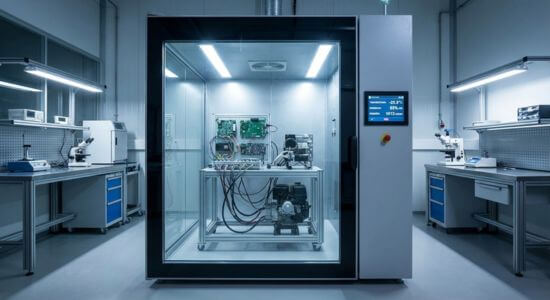
In industrial processes, the environment is not a secondary factor. Atmospheric conditions directly influence the thermal, mechanical, and functional behavior of materials, components, and systems. When these variables are not controlled, the environment becomes a source of uncertainty that complicates technical validation and decision-making.
Atmospheric condition simulation makes it possible to isolate and control these variables within a defined environment, turning climate into another parameter of the industrial process. Unlike tests conducted exclusively under real conditions, simulation provides stability, repeatability, and traceability key aspects when the objective is to analyze system performance in an objective manner.
The following sections outline the fundamental concepts that explain how atmospheric simulation is applied in industry and why it has become a standard tool during design, testing, and validation phases.
Atmospheric condition simulation consists of recreating environmental variables such as temperature, humidity, pressure, or radiation in a controlled manner within predefined ranges. Its purpose is not to generically reproduce climate, but to evaluate how a process, piece of equipment, or material responds when environmental conditions deviate from ideal assumptions.
This approach makes it possible to expose a system to specific scenarios—both nominal and extreme—and observe its behavior without compromising real operation. In this way, simulation becomes a technical analysis tool focused on failure prevention and industrial design optimization.
Tests under real conditions provide operational context, but they are subject to constant variations that are difficult to control. Unexpected weather changes, the inability to repeat identical scenarios, and dependence on external factors limit result accuracy.
Simulated conditions, by contrast, allow exact values to be fixed, tests to be repeated under the same parameters, and individual variables to be modified without affecting the others. This level of control facilitates result comparison, validation of design changes, and the generation of consistent data over time.
In environments where process reliability and stability are critical, atmospheric simulation acts as a preventive engineering tool. While it does not fully replace real-world testing, it reduces dependence on unpredictable trials and shortens validation cycles.
By integrating environmental simulation at early stages, organizations can identify deviations, adjust parameters, and strengthen designs before systems enter operation. This results in more robust processes, lower operational risk, and technical decisions based on reproducible data.
In industrial processes, the environment directly affects system and material performance and stability. However, its impact is not always detected during early development stages, which can lead to deviations or failures once the process enters real operation.
Simulating environmental conditions makes it possible to anticipate these scenarios under controlled and repeatable environments. By turning climate into a measurable variable, organizations can reduce uncertainty and make better-informed technical decisions prior to field validation.
Testing under real conditions is subject to hard-to-control variability and offers limited repeatability. It also depends on external factors that can extend validation timelines and increase process costs.
Validating a process without accounting for environmental conditions can mask issues that only appear in later stages. This often leads to more costly corrective actions and reduced operational reliability.
Moderate changes in temperature, humidity, or pressure can cause significant deviations in system behavior. Simulation allows these variables to be isolated and their actual impact to be objectively assessed.
Atmospheric simulation enables precise control of environmental variables that directly influence the behavior of processes, materials, and equipment. The technical value lies not in analyzing a single parameter, but in defining stable ranges and representative combinations of real operating environments.
These variables can be simulated individually or jointly, depending on test objectives and process requirements.
Temperature is one of the most critical variables in any industrial environment. Its control allows evaluation of thermal stability, material expansion, and system performance under nominal or extreme conditions.
Humidity affects condensation, corrosion, and the behavior of sensitive materials. Simulating it in a controlled manner makes it possible to identify risks associated with dry, humid, or saturated environments, particularly in long-duration processes.
Simulating ambient pressure and altitude is essential for equipment designed to operate under specific conditions. It allows reproduction of environments that are not naturally accessible in a conventional laboratory and validation of system behavior under those scenarios.
Exposure to saline environments accelerates corrosion processes in materials and components. Through simulation, system resistance and durability under these conditions can be evaluated without long real-world exposure periods.
Solar radiation and prolonged exposure to ultraviolet light can degrade materials and surfaces. Simulating these factors enables accelerated aging analysis and anticipation of performance losses or changes in material properties.
In many cases, environmental variables do not act in isolation. Combining climatic conditions with vibration or mechanical loads makes it possible to reproduce more demanding scenarios that are closer to real system operation.
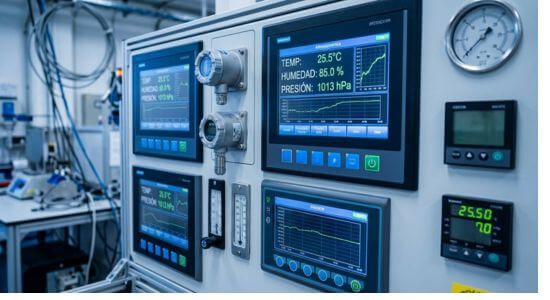
Atmospheric condition simulation in industry can be approached from different perspectives, depending on the project phase and the objectives of the test. In general terms, these approaches are grouped into two complementary categories: physical simulation and digital simulation.
While physical simulation makes it possible to evaluate the real behavior of a system under controlled conditions, digital simulation facilitates early analysis and design optimization before physical testing is carried out.
Physical simulation is based on the controlled recreation of environmental variables within enclosed environments. Using dedicated equipment, materials and systems can be exposed to defined conditions and their behavior observed in a reproducible manner.
Commonly used equipment includes climatic chambers for temperature and humidity control, thermal shock chambers for abrupt temperature changes, salt spray chambers for corrosion testing, and UV aging chambers to analyze degradation caused by solar radiation.
Digital simulation enables the analysis of a system’s environmental behavior through computational models before manufacturing or physical testing. Using thermal modeling and fluid dynamics simulation tools, it is possible to predict temperature distributions, airflow patterns, and thermal loads.
This approach not only optimizes design but also has a direct impact on reducing costs and lead times. By eliminating unfeasible configurations in the virtual environment, costly failed physical prototypes are avoided and the energy consumption associated with repeated testing is reduced. It is an ideal complement for accelerating time-to-market in projects where budget efficiency is as critical as technical performance.
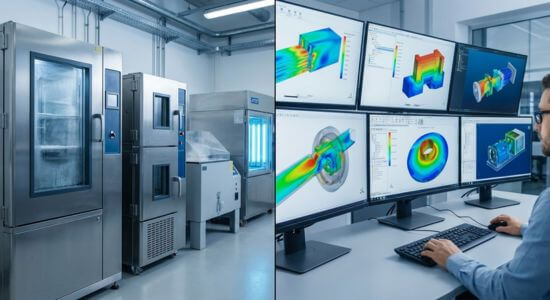
Atmospheric condition simulators are designed to create stable, controlled, and repeatable environmental environments, capable of maintaining defined parameters over extended periods or subjecting a system to controlled variations according to the required test. Their objective is not only to reach a specific value, but to maintain it with precision and traceability over time.
The operation of these systems is based on the continuous regulation of environmental variables through the combination of energy generation, control systems, and distributed sensors that monitor the environment in real time.
To achieve high levels of accuracy, simulators incorporate specific technologies such as cascade refrigeration systems for extreme temperatures, control of progressive or abrupt thermal ramps, capacitive sensors for humidity control, and barometric regulation systems for altitude testing.
To reach high levels of precision and stability, environmental simulators integrate dedicated technologies adapted to industrial requirements. Among the most common are cascade refrigeration systems used to achieve extremely low temperatures, and thermal control systems capable of managing heating and cooling ramps in either progressive or rapid modes.
The validity of a test depends on the system’s ability to maintain environmental variables within tight tolerances. Continuous control prevents unwanted fluctuations and ensures that results accurately reflect the real behavior of the process or equipment under analysis.
Atmospheric simulation makes it possible to repeat the same test under identical conditions, facilitating result comparison and validation of design modifications. The recording of environmental parameters ensures test traceability and supports technical decision-making based on reliable data.
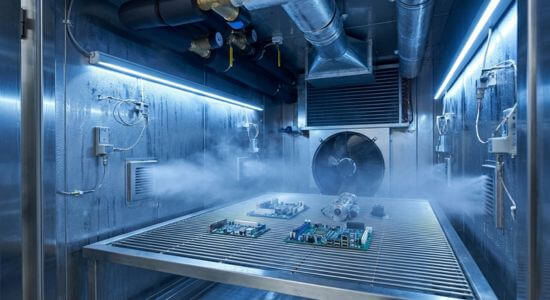
When evaluating the behavior of an industrial process, a common question arises: is it better to test under real conditions or in a simulated environment? Both approaches provide value, but they serve different objectives.
Laboratory-based environmental simulation stands out for its high level of control and repeatability, while field testing allows observation of behavior under real operating conditions. Understanding their differences helps determine the most appropriate approach at each stage of the process.
Although both approaches aim to evaluate process behavior, they do not offer the same level of control or the same type of information. While field testing depends on changing and often unpredictable conditions, environmental simulation makes it possible to isolate variables and analyze their impact with precision. The following comparison summarizes the main differences from a technical and operational perspective.
| Criterion | Laboratory environmental simulation | Field testing |
|---|---|---|
| Control of variables | Total and precise | Limited and environment-dependent |
| Test repeatability | High, identical conditions | Low, difficult to replicate |
| Validation time | Reduced and predictable | Variable and weather-dependent |
| Operating costs | Controlled and predictable | Higher and uncertain |
| Results analysis | Comparable and traceable data | Condition-dependent results |
| Failure detection | Anticipatory | Reactive |
Environmental simulation is particularly suitable during design, optimization, and pre-validation phases, where it is necessary to isolate variables and analyze their impact under controlled conditions. It enables the identification of deviations, parameter adjustment, and risk reduction prior to commissioning.
Field testing, on the other hand, is more appropriate in final stages, when the objective is to verify system behavior under real operating conditions. In this context, simulation and field testing are not mutually exclusive approaches, but complementary elements within a robust industrial validation strategy.
Atmospheric condition simulation is applied across multiple industrial sectors where the environment directly influences performance, safety, or durability. Its value lies not in the sector itself, but in the ability to anticipate behavior under controlled scenarios before exposing a system to real operating conditions.
In the automotive industry, environmental simulation enables the evaluation of components and systems subjected to thermal variations, humidity cycles, or pressure changes. These tests help validate material and system behavior prior to final integration, reducing risks during production and operation phases.
Electronic systems are particularly sensitive to environmental conditions. Simulation makes it possible to analyze how temperature and humidity affect performance, stability, and component lifespan, supporting more robust design decisions.
En el sector energético y en sistemas industriales complejos, la simulación ambiental ayuda a validar equipos destinados a operar en condiciones variables o exigentes. Esto resulta clave para asegurar continuidad operativa y minimizar fallos derivados del entorno.
Beyond any specific sector, atmospheric simulation is used as a validation tool in processes where reliability is critical. It allows equipment and processes to be subjected to defined scenarios and their behavior evaluated without compromising real-world operation.
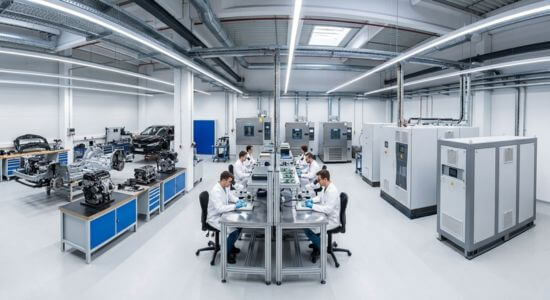
Beyond specific applications, environmental simulation provides clear technical advantages when integrated as part of the validation and continuous improvement process.
By working under controlled conditions, it is possible to identify anomalous behaviors and adjust parameters before they become real issues. This increases overall process reliability.
Simulation transforms unpredictable environmental variables into measurable parameters. This reduces uncertainty and enables technical decisions based on consistent data.
Testing in simulated environments accelerates validation cycles and reduces the need for later corrective actions. The result is more efficient development, better aligned with operational requirements.
Having comparable and reproducible data facilitates technical analysis and the justification of decisions, especially in complex or critical processes.
In an increasingly demanding industrial context, understanding and controlling the environment shifts from being a secondary factor to becoming a strategic variable. Atmospheric condition simulation makes it possible to transform uncertain scenarios into measurable environments, enabling more rigorous validation of processes, systems, and components.
By integrating environmental simulation into the design and testing phases, organizations reduce their reliance on unpredictable trials and improve the quality of the data used for technical decision-making. The result is more stable, repeatable industrial processes aligned with real operating requirements—even before commissioning.
Having atmospheric simulation solutions specifically designed for industrial environments, such as those developed by FTM Technologies, enables environmental testing with a high level of control, precision, and traceability, tailored to the technical and regulatory requirements of each application.
If your process requires validation of behavior under controlled environmental conditions, properly defining the simulation scenario is the first step toward obtaining reliable and technically meaningful results.
Trust FTM Technologies to advance the simulation of atmospheric conditions for your industrial processes, with solutions designed to accurately and reliably reproduce controlled environments aligned with current technical requirements.
La simulación atmosférica es especialmente necesaria cuando el entorno influye de forma crítica en el rendimiento, la fiabilidad o la durabilidad de un proceso, y cuando validar únicamente en condiciones reales supone riesgos técnicos o elevados costes operativos.
No. La simulación ambiental y las pruebas en campo son enfoques complementarios. La simulación permite validar y optimizar el proceso en entornos controlados, mientras que las pruebas en campo verifican el comportamiento final en condiciones reales de operación.
En función del equipo y del objetivo del ensayo, es posible combinar variables como temperatura, humedad, presión, corrosión, radiación UV e incluso vibración, para reproducir escenarios complejos y representativos del entorno real.
Las normativas definen cómo deben realizarse los ensayos, qué parámetros controlar y cómo interpretar los resultados. Trabajar bajo estándares reconocidos garantiza la validez técnica, la trazabilidad y la aceptación de los ensayos en procesos de certificación y auditoría.
Un proveedor especializado aporta conocimiento técnico, capacidad de adaptación a cada proceso y experiencia en el diseño de soluciones alineadas con normativas industriales. Empresas como FTM Technologies ofrecen simuladores de condiciones atmosféricas orientados a la validación ambiental de procesos industriales, con un enfoque técnico y personalizado.