
Wind is one of the most studied natural forces in modern engineering, and understanding how it interacts with different objects is key to safe, efficient, and optimized designs. Wind tunnels offer an irreplaceable solution for this: they allow for the precise reproduction of real-world aerodynamic conditions in a controlled environment.
This article explores step by step how a wind tunnel operates, the physical principles that make it possible, its main components, and how an aerodynamic test is conducted to obtain reliable and repeatable data.
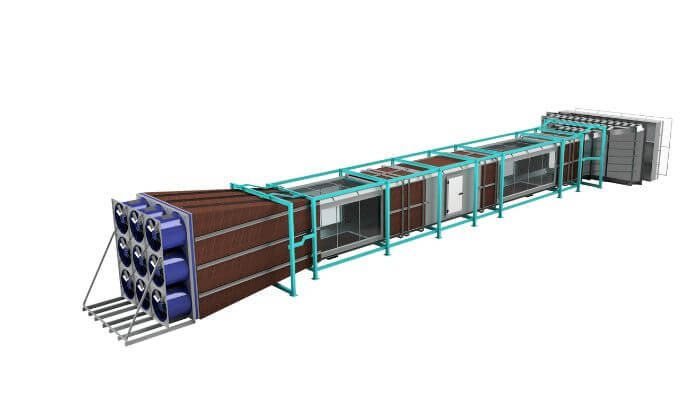
A wind tunnel is an experimental facility designed to study the behavior of air as it interacts with fixed objects, by controlled simulation of the aerodynamic conditions that occur when those objects are in motion.
Through the generation of a stable and measurable airflow, it is possible to accurately analyze forces such as lift, drag, and pressure distributions over a given geometry.
From a functional standpoint, a wind tunnel is used to reproduce, observe, and quantify aerodynamic phenomena under controlled conditions, enabling the validation of designs, the optimization of configurations, and the anticipation of real-world behavior prior to practical application. In essence, it turns airflow into a repeatable and reliable experimental variable.
To understand why a wind tunnel works, it is necessary to examine the physical principles that make its operation possible. These scientific foundations explain how air behaves in motion, how it responds to the presence of obstacles, and how its effects can be measured with accuracy. In other words, it is not sufficient to simply move air: it must be done in a controlled, stable, and predictable manner. The following sections explore the fundamental principles that explain how and why a wind tunnel is capable of simulating real aerodynamic flow conditions.
Bernoulli’s principle: as air velocity increases, static pressure decreases. This relationship between pressure and velocity is fundamental for the analysis of aerodynamic forces.
Reynolds number: it determines whether the flow regime is laminar or turbulent and directly affects how air behaves around an object.
Mach number: it indicates the ratio between the flow velocity and the speed of sound and is critical for testing in the supersonic regime.
Flow continuity: when the cross-sectional area of the duct is reduced, air velocity increases, enabling the generation of controlled test conditions.
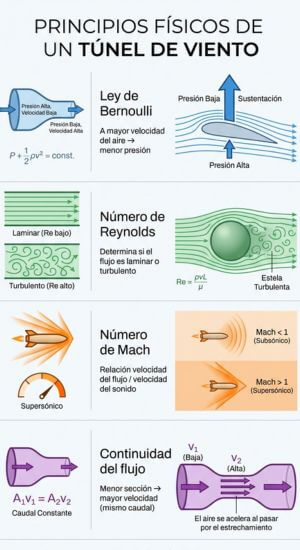
These principles make it possible to predict and control air behavior as a function of the tunnel design and the object under test.
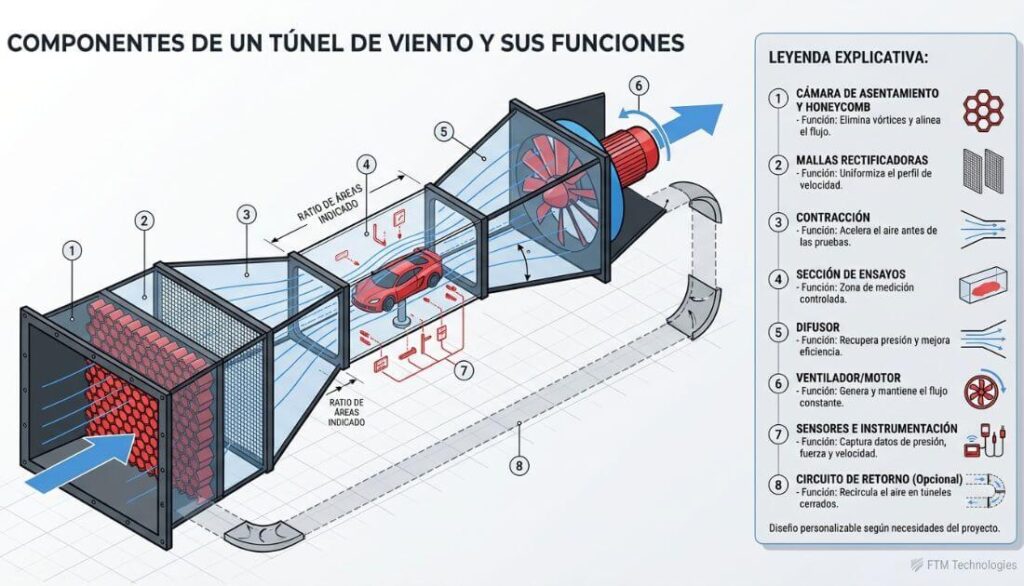
The air inside a wind tunnel follows a carefully designed flow path that ensures optimal conditions for acquiring accurate data. Each stage of this path serves a specific function and relies on key system components:
The airflow enters the settling chamber, where it passes through flow-straightening screens and honeycomb structures. Their function is to eliminate swirl, vortices, and residual turbulence generated by the fan, ensuring a uniform and well-aligned flow before acceleration.
The air passes through a converging nozzle that reduces the flow cross-sectional area and, therefore, increases the flow velocity in a controlled manner. At this stage, the principles of Bernoulli and flow continuity are directly applied to obtain a clean, accelerated stream that impinges on the model in a repeatable way.
It is the core of the wind tunnel. This is where the model to be studied is installed. The flow interacts directly with the object while sensors and data acquisition systems record parameters such as drag and lift forces, pressure distribution, or flow visualization. The walls are typically transparent to facilitate observation and optical analysis.
After passing the model, the air enters the diffuser, a divergent section that reduces flow velocity and recovers static pressure. This process improves the energy efficiency of the system and helps stabilize the flow before the next cycle.
The fan is the driving element of the wind tunnel, providing the energy required to move the air at a constant rate. In closed-circuit tunnels, the flow is not exhausted after the diffuser but instead redirected through a return system with curved guide vanes that preserve flow quality. This configuration enables energy savings and helps maintain stable and repeatable conditions.
An aerodynamic test is a carefully designed process that is carried out through several technical and sequential stages:
Model installation and sensor calibration
Flow stabilization until the desired conditions are reached
Data acquisition through sensors and flow visualization systems
Real-time or post-test analysis of the measured variables
Throughout the entire process, the objective is to reproduce conditions that are as realistic as possible within a controlled laboratory environment.
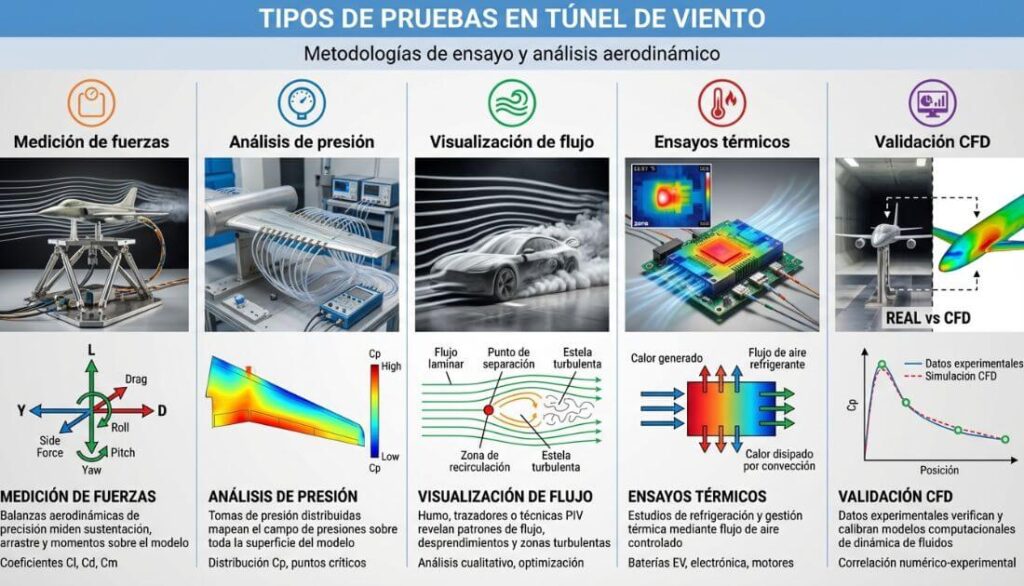
Wind tunnel testing does not always involve the same types of experiments, as each test is designed to address specific measurement or validation objectives. Depending on the model, the design stage, and the data sought, different test procedures and configurations are selected. In addition, the range of tests that can be performed is constrained by the type of wind tunnel used, its configuration, and its operational characteristics.
Measurement of aerodynamic forces (lift, drag)
Measurement of aerodynamic forces (lift, drag)
Flow visualization using smoke or tracers
Cooling or ventilation testing
CFD model validation
Wind tunnels are extremely precise and reliable tools when used correctly. However, many of the errors that affect the validity of tests do not originate from the tunnel itself, but from how the experiment is designed, how the model is installed, or how the results are interpreted. Identifying these issues is essential to avoid erroneous conclusions or unusable data.
Failure to properly calibrate sensors
Non-uniform flow in the test section
Incorrect model installation
Ignoring scale effects (when the model does not accurately represent the real object)
Underestimating the importance of the diffuser and flow conditioning
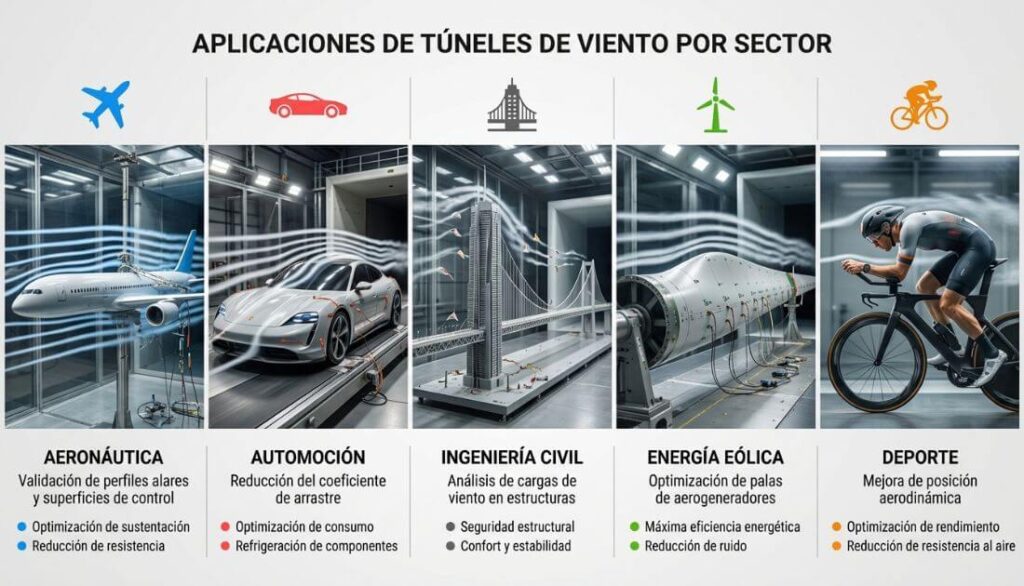
The applications of wind tunnels are not the starting point, but rather the direct consequence of their ability to simulate, measure, and analyze airflow behavior over fixed objects. Thanks to this level of technical precision, they have become key tools for solving specific design, validation, or performance challenges across multiple contexts.
Aeronautics: validation of airfoil profiles and control surfaces
Automotive: drag coefficient reduction and component cooling
Architecture: wind load analysis on tall buildings and bridges
Wind energy: optimization of wind turbine blade design
Sports: improvement of the aerodynamic position of cyclists or athletes
Understanding how a wind tunnel works makes it possible to appreciate its importance in technological and scientific development. Behind every test lies a precise system that transforms airflow into valuable data. Having a specialized provider of wind tunnels and flow conditioning systems—one that masters all these aspects, from aerodynamics to instrumentation—makes the difference between a generic test and a useful, reliable result.
At FTM Technologies, we design and implement custom wind tunnels for demanding industries.
Let’s talk about your project.
Development tests are conducted during early design phases to explore solutions and optimize the model. Validation tests are carried out in the final stages to confirm that the design meets the technical and regulatory requirements.
Modern wind tunnels can feature full automation: from flow control to model positioning, data acquisition, and real-time analysis. This improves accuracy and reduces human error.
It is selected based on the available test section space, the desired Reynolds number, and the level of detail required. The goal is to achieve dynamic similarity without compromising the representativeness of the full-scale object.
Yes, but specific instrumentation and acoustic conditioning of the tunnel are required. This is common in aeroacoustic studies and advanced aeroelasticity research.
It is essential to regularly calibrate sensors, clean flow screens and straighteners, inspect fans, and verify the control system to ensure test stability.
FTM Technologies is a leading reference in Spain for advanced technical solutions involving wind tunnels. It offers design, simulation, instrumentation, and custom testing for engineering, architecture, and R&D, with expert guidance at every stage of the project.