
In the field of engineering and aerodynamics, wind tunnels are facilities designed to generate controlled airflow over stationary objects. Although their internal operation can be complex, what truly matters is understanding what types of wind tunnels exist, which ones are best suited to each project, and the specific purpose of each.
The following sections present a clear and comparative classification that will help support informed decision-making based on the intended objective.
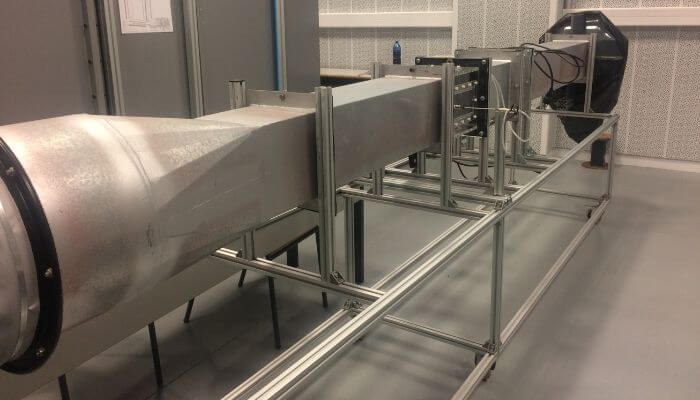
Understanding how wind tunnels operate is key to understanding how they can be classified according to multiple technical criteria, each addressing specific testing, optimization, or research needs in industrial and scientific contexts. There is no “universal” wind tunnel suitable for every application: each type is optimized for specific uses, defined velocity ranges, and particular measurement objectives.
Proper classification makes it possible to quickly identify which configuration delivers the best results for each case, optimizing both investment efficiency and the quality of the data obtained.
Before selecting or designing a wind tunnel, it is essential to understand the different ways in which wind tunnels can be classified. This technical classification makes it possible to accurately assess which option is best suited for each specific application.
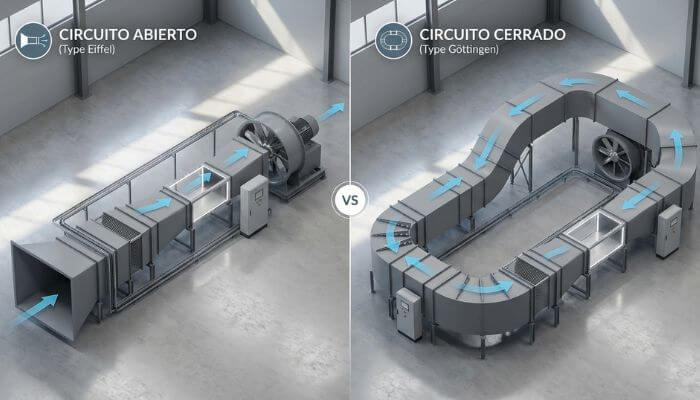
The configuration of the airflow circuit is one of the most important decisions in wind tunnel design, as it directly affects flow quality, operating costs, and measurement accuracy.
Technical characteristics: ambient air is drawn in, conditioned, and passed through the test section; it is then exhausted back to the atmosphere. The flow path is essentially linear, with no recirculation.
Advantages:
Lower structural complexity: it typically requires fewer ducts and fewer return elements.
Always “fresh” air: it facilitates smoke or fog visualization tests without accumulation.
Simple operation, well suited for educational laboratories or versatile test benches.
Limitations:
More sensitive to ambient conditions: temperature, humidity, and pressure can introduce variability.
Higher inlet conditioning requirements when high flow uniformity is needed.
Noise and air exhaust: it may require soundproofing or filtration measures.
Typical applications: preliminary validations, educational institutions, R&D activities with constrained budgets, and tests that require frequent flow visualization.
Technical characteristics: the air circulates in a closed loop within the facility. After passing through the test section, it flows through diffusers and return passages (including corners with turning vanes or guide vanes) and then returns to the contraction section to re-enter the test chamber.
Advantages:
Greater control of conditions: the system maintains a more stable and repeatable flow.
Better energy efficiency during sustained operation by recirculating the air.
Lower external acoustic impact in many configurations.
Limitations:
Higher initial investment: more complex structure, return circuit, and components.
Thermal management: during long-duration tests, it may be necessary to control air heating.
More demanding maintenance due to a higher number of components and less accessible areas.
Typical applications: repetitive, high-precision testing (automotive, aerospace, research centers) where repeatability is critical.
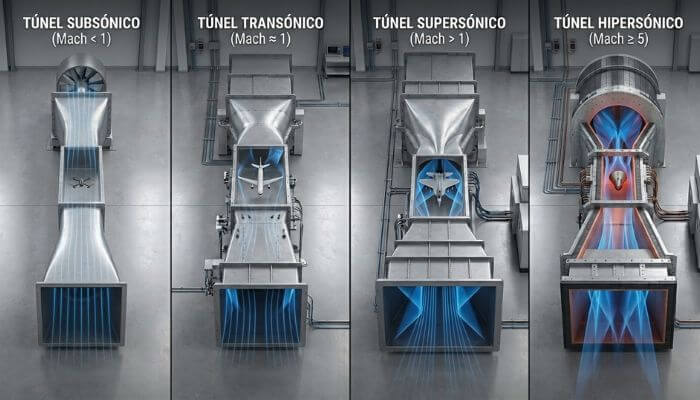
The velocity regime defines the aerodynamic phenomena that can be studied and the tunnel requirements, including internal geometry, instrumentation, and control systems.
Air compressibility effects are negligible. They account for approximately 85% of all wind tunnels in operation worldwide.
Main sectors:
Typical applications:
Advantages:
Flow with simultaneous subsonic and supersonic regions. Local shock waves appear. They require slotted or perforated test sections to relieve pressure disturbances.
Typical applications:
Technical challenges
They operate entirely above the speed of sound. They require Laval nozzles (convergent–divergent), vacuum systems, and the capability to handle intense shock waves.
Typical applications:
Complexity:
Extreme regime involving molecular dissociation, air ionization, and real-gas effects. They operate in “shot” mode with test durations of only a few seconds.
Applications:
Limitations:
Depending on the tunnel design and the way the air circulates, the test section can be either open or closed.
The closed test section is used in wind tunnels designed to provide a high degree of control and repeatability in airflow conditions.
Advantages:
Greater control of the flow and, in general, good repeatability.
It facilitates maintaining uniform conditions within the measurement zone.
Limitationes:
It can introduce wall effects (blockage) if the model occupies an excessively large relative volume.
The open test section is characterized by allowing air to flow directly from the surrounding environment through the test area and then be discharged back into the atmosphere.
Advantages:
It can reduce certain confinement effects, depending on the setup and the test objective.
Useful in specific free-jet configurations and flow visualization setups.
Limitations:
It requires a careful measurement approach and appropriate corrections to ensure comparability.

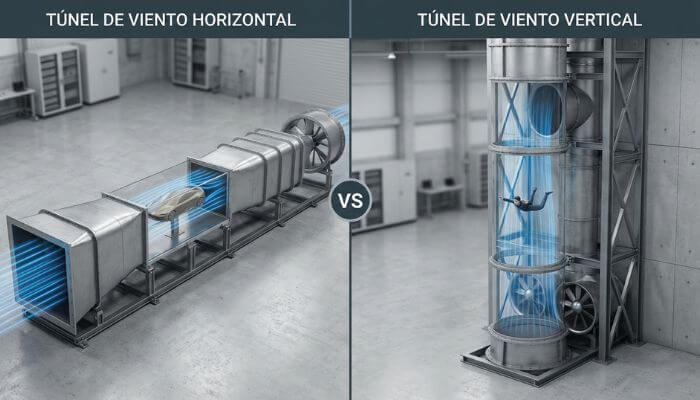
The orientation of the flow in a wind tunnel is a key design criterion, as it directly influences airflow stability, instrumentation layout, and the types of tests that can be performed.
Applications:
Advantages:
Vertical wind tunnels are characterized by an airflow that develops in an upward or downward direction, allowing the study of phenomena in which gravity and aerodynamic forces interact directly.
Characteristics: upward vertical flow that sustains objects in the air through drag. Highly specific applications.
Applications:
Limitaciones:
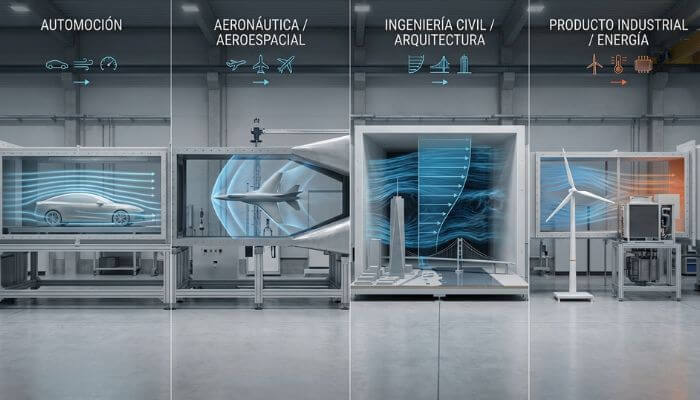
Wind tunnels are used across multiple industrial sectors as a key tool to analyze, validate, and optimize the behavior of products, installations, and processes subjected to airflow. Depending on the sector, the type of test, and the tunnel configuration, they enable very different objectives to be addressed, ranging from energy efficiency improvement to operational risk reduction, regulatory compliance, or experimental validation of complex designs.
In the automotive sector, wind tunnels are used to analyze and optimize vehicle aerodynamics, reduce aerodynamic drag, and improve energy efficiency.
Optimal configuration:
Specific applications:
Typical instrumentation:
In the aerospace sector, wind tunnels are essential for studying the aerodynamic behavior of aircraft, wings, fuselages, and critical components under different flight conditions.
optimal configuration:
Aplications:
Instrumentation:
In civil engineering, wind tunnels are used to analyze wind action on infrastructures such as tall buildings, bridges, towers, lightweight roofs, and singular structures. These tests allow the evaluation of aerodynamic loads, vibration effects, structural stability, and user comfort, as well as the optimization of designs against phenomena such as gusts, turbulence, or vortex shedding.
Optimal configuration:
Aplications:
Special features:
To facilitate the selection of the most suitable wind tunnel, we present a practical comparison between the different types. This table summarizes their key characteristics, advantages, and limitations based on the intended use and level of technical demand.
| Classification type | Characteristic | Typical application | Advantages | Limitations |
|---|---|---|---|---|
| Open circuit | Direct flow | Basic laboratory | Cost-effective, | simpleLower | flow control
| Closed circuit | Recirculation | Automotive, R&D | High precision, stable | Higher cost and complexity |
| Horizontal | Lateral airflow | Vehicles, buildings | Standard, versatile | Does not simulate free fall |
| Vertical | Upward airflow | Skydiving, microgravity | Simulates free fall | Less common |
| Subsonic | < < Mach 1 | Cars, drones | Suitable for most applications | Does not allow supersonic studies |
| Supersonic | > < Mach 1 | Missiles, rockets | Realistic high-speed conditions | Costly, complex |
Different types of wind tunnels present specific advantages and limitations that directly influence their suitability for technical projects. Understanding these differences makes it possible to select the most appropriate option based on project objectives and specific requirements.
Open-circuit wind tunnels are accessible but less precise.
Closed-circuit wind tunnels offer higher data quality but require greater investment.
Subsonic wind tunnels cover the majority of real-world applications.
Supersonic wind tunnels are critical in aerospace industries.
Vertical orientation is highly specialized but indispensable for certain tests.

Knowing which type of wind tunnel is required involves considering both the test objective and the conditions under which it will be conducted:
If you are looking for preliminary or educational testing, an open-circuit subsonic wind tunnel may be sufficient.
If you need to validate designs for real vehicles or structures, a closed-circuit horizontal wind tunnel is preferable.
For flight simulations or extreme operating conditions, a transonic or supersonic wind tunnel is required.
If your project involves free-falling objects, only a vertical wind tunnel can fulfill that function.
In all cases, working with an expert provider such as FTM Technologies, capable of designing fully custom wind tunnels ensures that each installation is precisely tailored to the client’s technical requirements.
At FTM Technologies, we design and implement custom wind tunnels for demanding industries.
Let’s talk about your project.
It depends on the application: compact tunnels are used for reduced-scale testing, while industrial facilities can exceed 50 meters in length to accommodate full vehicles or large structural components.
Pressure sensors, load cells, high-speed cameras, anemometers, and flow visualization systems are commonly deployed to capture accurate aerodynamic data during testing.
Yes. Many wind tunnels allow adjustments to the test section, airflow velocity, or instrumentation, enabling adaptation to new testing requirements without replacing the entire facility.
It depends on operational intensity. High-precision closed-circuit tunnels require more frequent servicing of motors and control systems, whereas open-circuit tunnels typically demand less maintenance.
Academic tunnels are designed for education and fundamental research. Industrial tunnels prioritize measurement accuracy, environmental control, and compliance with technical standards for certified testing.
FTM Technologies specializes in the design, manufacturing, and validation of custom wind tunnels in Spain, delivering turnkey solutions for sectors such as automotive, aerospace, and civil engineering.